It is here. As I type, we're less than nine hours away from first pitch in ALDS G1. I've already called in sick for tomorrow (can't today) but - how's this for irony? - I'm actually sick. Playoff Fever, baby, catch it! I don't know about you, but I'm an absolutely bundle of nerves. Within seconds I go from dreaming about going to the parade in downtown Houston to thinking about how I'm going to write the postmortem after the Astros get swept by Boston. This is what we wanted, I guess. So let's make some jokes and do some reading.
*Flick Nickem has your ALDS Bingo Cards ready for you to download.
*Five key Statcast facts to note during the ALDS.
*ESPN's Jerry Crasnick has a great piece on how the Astros' lineup is built to roll through October, and how the organization's philosophy has changed over the last four years.
*Verlander is honored to start G1, and complimentary of the rest of the rotation:
I've been lucky to be part of some pretty great pitching staffs where anybody can go No. 1 the first game and you don't feel like you're team's any different than if the other guy goes No. 1...It's a great situation to be on because...the weight of the world doesn't fall on your shoulders to have to win that game.
*Verlander said yesterday that there's a special buzz in the clubhouse.
*Josh Reddick is ready to go.
*Carlos Correa learned a few lessons from 2015 ALDS G4, and is ready for a deeper run. Hinch, on Correa:
He's so driven to be great, and most of the great ones are. I mean, it's how they're built and how they go about it. But I love how he takes it personal when people challenge him about playing shortstop, and I love how personal he takes it in being in the middle of the order and wanting to be the most productive hitter on the team.
*This is just great. ALDS G3 at Fenway will start at 1:38pm Central. My kingdom for a playoff night game. What a joke.
*The Dallas Morning News' Evan Grant and Gerry Fraley both picked Red Sox in five.
*Baseball saved Chris Devenski from gang life.
*The San Diego Union-Tribune is unsurprised by hometown boy Joe Musgrove's success.
*An oral history of Carlos Beltran's 2004 postseason.

We didn't come out here to play tiddlywinks, son.
-Hal Smith
Showing posts with label 2015. Show all posts
Showing posts with label 2015. Show all posts
Thursday, October 5, 2017
Wednesday, October 12, 2016

Friday, June 24, 2016
The damage done by Edinson Volquez
On July 1, 2015 the Astros hosted the Kansas City Royals.
George Springer was 1x2 with a stolen base and a run scored when he faced Edinson Volquez for the 3rd time of the game in the 5th inning. Volquez drilled him in the wrist, which fractured Springer's wrist, and knocked him out until September 4.
Springer was hitting .264/.365/.457 with 13 homers, 14 doubles, and 14 stolen bases at the time of the HBP. The Astros won that game against the Royals - 6-5 - to improve to a 47-34 record, five games up in the division. But in the ten games remaining before the All-Star Break the Astros would go 2-8, losing two of three at Boston, three of four at Cleveland, and getting swept by Tampa Bay. Six of those losses were by 1-2 runs.
Over the 53 games that Springer missed in his recovery from Volquez's pitch the Astros would go 26-27 and trade for Carlos Gomez, in part partially because an ineffective Jake Marisnick was getting significant playing time in the outfield.
From Right Field the Astros got .260/.346/.441 from the beginning of the 2015 season to the end of the Volquez game on July 1. From the next game until Springer's return Astros RFs put up a .224/.280/.353 line.
When Springer returned to the lineup on September 4 the Astros were 73-61, still with a two-game lead in the AL West. He would hit .304/.373/.464 in the 27 regular season games before the playoffs began and of course the Astros went 12-15 in those games because the bullpen was absolutely terrible. The Astros didn't lose their lead in the division until September 15, and 11 of their losses from September 1 through the end of the regular season were charged to various members of the bullpen.
I'm not saying that Edinson Volquez took the division away from the Astros - the Astros did that on their own just fine - but Volquez's HBP took out a significant part of the Astros' lineup and impacted how the team was constructed in an effort to keep their feet down on the division.
George Springer was 1x2 with a stolen base and a run scored when he faced Edinson Volquez for the 3rd time of the game in the 5th inning. Volquez drilled him in the wrist, which fractured Springer's wrist, and knocked him out until September 4.
Springer was hitting .264/.365/.457 with 13 homers, 14 doubles, and 14 stolen bases at the time of the HBP. The Astros won that game against the Royals - 6-5 - to improve to a 47-34 record, five games up in the division. But in the ten games remaining before the All-Star Break the Astros would go 2-8, losing two of three at Boston, three of four at Cleveland, and getting swept by Tampa Bay. Six of those losses were by 1-2 runs.
Over the 53 games that Springer missed in his recovery from Volquez's pitch the Astros would go 26-27 and trade for Carlos Gomez, in part partially because an ineffective Jake Marisnick was getting significant playing time in the outfield.
From Right Field the Astros got .260/.346/.441 from the beginning of the 2015 season to the end of the Volquez game on July 1. From the next game until Springer's return Astros RFs put up a .224/.280/.353 line.
When Springer returned to the lineup on September 4 the Astros were 73-61, still with a two-game lead in the AL West. He would hit .304/.373/.464 in the 27 regular season games before the playoffs began and of course the Astros went 12-15 in those games because the bullpen was absolutely terrible. The Astros didn't lose their lead in the division until September 15, and 11 of their losses from September 1 through the end of the regular season were charged to various members of the bullpen.
I'm not saying that Edinson Volquez took the division away from the Astros - the Astros did that on their own just fine - but Volquez's HBP took out a significant part of the Astros' lineup and impacted how the team was constructed in an effort to keep their feet down on the division.


Tuesday, May 3, 2016
This Was Not Inevitable
There was a lot of optimism heading into the season. I personally predicted 93 wins, an easy playoff berth, and then, who knows? It obviously has not worked out that way, so far. 93 wins seems out of the question, at this point, and .500 is becoming more and more of a pipe dream. I've been seeing a lot of talk about how the expectations were flawed, and we should have seen this coming. After all, last year's Astros just snuck into the playoffs with 86 wins, and after their 10 game win streak in April put them 11 games over .500 on May 3, they finished the season 68-69. Then, they proceeded to make very few changes over the offseason, adding a closer set up guy low leverage reliever and a potential 4th/5th starter. Maybe we shouldn't have expected 8-18, but were the pie in the sky expectations justified?
I think they answer is yes, they were justified. Which in some ways makes this season even more disappointing. Yes, the Astros finished at 86-76, but they also finished with a +111 run differential. They scored the fifth most runs in the American League, and allowed the fewest. We can come up with explanations for why this is, but I think it's safe to say that if they repeated those numbers in 2016, they'd be far better than 86-76, and would finish much closer to their Pythagorean record of 93-69. (I didn't just make my prediction up).
And, Correa was going to get a full season of at bats. Gomez too (who, despite what you may remember, finished the season hitting .318/.370/.571 in his last 19 games last year). The rotation that had the second lowest ERA in the AL, with the third lowest FIP and xFIP, was going to replace 24 starts from Scott Kazmir and Roberto Hernandez with Doug Fister. No loss there, and a potential gain. The bullpen, which, September struggles aside, ended the year easily among the top 5 in the AL, added the fireballer every one said they needed. There was very little reason to expect them to get much worse than their +111 run differential, and a lot of reason to hope they'd get better.
Instead, the bottom fell out in nearly every way it could. The fireball reliever became a HR machine. The reigning Cy Young award winner is sporting a 5+ ERA. The pitching staff that allowed the fewest runs in 2015 has allowed the most in the AL in 2016. The hitting has also dropped to 8th in the league, with some of the worst RISP at bats you can see.
If the Astros were sitting with a +20 run differential, and were below .500 or worse, then we could start talking about whether the lineup construction or plate approach is producing a team that consistently under performs their RS/RA. And how, because of that, maybe we should have kept our expectations in check.
But that's not what happened. The 2015 team was not a fluke, and they were not lucky. They were a good team, that, if anything, under performed. The -36 run differential so far is shocking because it came out of the blue.
The good news is that this is mostly the same team that had a +74 run differential from May 3 on. If they manage to repeat that, history says they will be much better than 68-69. Whether they will or not is another question entirely.
I think they answer is yes, they were justified. Which in some ways makes this season even more disappointing. Yes, the Astros finished at 86-76, but they also finished with a +111 run differential. They scored the fifth most runs in the American League, and allowed the fewest. We can come up with explanations for why this is, but I think it's safe to say that if they repeated those numbers in 2016, they'd be far better than 86-76, and would finish much closer to their Pythagorean record of 93-69. (I didn't just make my prediction up).
And, Correa was going to get a full season of at bats. Gomez too (who, despite what you may remember, finished the season hitting .318/.370/.571 in his last 19 games last year). The rotation that had the second lowest ERA in the AL, with the third lowest FIP and xFIP, was going to replace 24 starts from Scott Kazmir and Roberto Hernandez with Doug Fister. No loss there, and a potential gain. The bullpen, which, September struggles aside, ended the year easily among the top 5 in the AL, added the fireballer every one said they needed. There was very little reason to expect them to get much worse than their +111 run differential, and a lot of reason to hope they'd get better.
Instead, the bottom fell out in nearly every way it could. The fireball reliever became a HR machine. The reigning Cy Young award winner is sporting a 5+ ERA. The pitching staff that allowed the fewest runs in 2015 has allowed the most in the AL in 2016. The hitting has also dropped to 8th in the league, with some of the worst RISP at bats you can see.
If the Astros were sitting with a +20 run differential, and were below .500 or worse, then we could start talking about whether the lineup construction or plate approach is producing a team that consistently under performs their RS/RA. And how, because of that, maybe we should have kept our expectations in check.
But that's not what happened. The 2015 team was not a fluke, and they were not lucky. They were a good team, that, if anything, under performed. The -36 run differential so far is shocking because it came out of the blue.
The good news is that this is mostly the same team that had a +74 run differential from May 3 on. If they manage to repeat that, history says they will be much better than 68-69. Whether they will or not is another question entirely.
Wednesday, October 21, 2015
"Playing With House Money": A Count/PointerCount discussion
Not Hank and I exchanged testy emails today over the validity of the "playing with house money" idea and winning before your favorite team is expected to be good. Here it is:
Okay, Not Hank. You and I disagree on something major and yet insignificant at the same time: I think that the idea of baseball teams winning more quickly than expected, or playing with house money, is an empty idea - a defense mechanism for disappointment. Why do I think this?
Okay, Not Hank. You and I disagree on something major and yet insignificant at the same time: I think that the idea of baseball teams winning more quickly than expected, or playing with house money, is an empty idea - a defense mechanism for disappointment. Why do I think this?
Success in baseball is not guaranteed. Just because the Astros were better than Buster Olney, Keith Law, etc. expected them to be, and didn't expect them to be good until 2017, it doesn't mean that the Astros didn't waste a gigantic opportunity.
We can look back with hindsight and see that the Astros should have pulled the trigger on Kimbrel or Chapman. We also don't really know what San Diego and Cincinnati were asking in return for two of the best closers in baseball, and it must have been a lot, seeing as how they played out their days on meaningless teams in a meaningless existence. Scott Kazmir was so bad that he actually hurt the team's playoff chances - not something you expect from a major trade deadline acquisition.
But by the time the bullpen imploded, it was too late to do anything about it. Rightfully so, the Astros thought the bullpen could right itself in September, as they had performed pretty damn well to that point in the season. Yeah, there were skids, but nothing like the bottom falling out and reminding us all of what it was like in 2011-14 - just a feeling of dread whenever the starter wouldn't throw a Maddux.
Still, the Astros joined/will join 29 other teams in not winning the World Series this year. And there's a lot to feel good about with the Astros heading into 2016 and beyond. But I'm not going to take solace in the Astros "playing with house money," because it assumes the Astros will have more success in 2016, and 2017, and...ad infinitum.
I'm not willing to make that jump. When Bryce Harper found out the Nationals had landed Max Scherzer he asked, "Where's my ring?" Look at the Nationals now: you can't, because they're all dead. I'm willing to assume that the Astros should be good for the foreseeable future, but I'm not going to assume they'll skate into the postseason every year because they did it this year, when all but maybe 30 people in the world didn't think they had a chance.
Now, you were saying?
----
First off, this concept that the only successful outcome of a baseball season is a World Series Championship, is just flat out something that I cannot agree with. That's how a Yankees fan sees baseball. I hate how Yankees fans see baseball. I will most likely weep uncontrollably for a good three months when the Astros win their first. Our Christmas pictures will be awful. But, what does that have to do with this year? You and I muddled through the Crynasty. We blogged about it. We tweeted about. We joked about it. But we hated every minute of it. I don't remember exactly what you said, but it was something about Luhnow was either going to be the reason your kids were Astros fans for life or hated baseball forever. In the middle of 111 losses, I could see it going either way. After Correa broke his leg, and Appel continued to struggle, and the Aiken thing blew up. I got really nervous that it was leaning the other way. We were so disillusioned by bad baseball, that some of us were over the moon ecstatic by just not losing 100 games. 70-92 is awful, yet we were celebrating it. I tweeted something lauding the fact that they were only 4 games under .500 for a 50 game stretch or something. I am not proud of that, but we were desperate.
So what are looking for in baseball season? And what does it mean that "the Astros were playing with house money?" The enjoyment of baseball, to me, is about hope, not guarantees. The 2011 -14 seasons were marked, most of all, by the absence of hope. We knew the plan, and maybe could put some hope in that plan. But the plan was ephemeral. It offered no real comfort when the Astros lost 15 straight games to end the season. No real comfort when Robbie Grossman was in the outfield instead of J.D. Martinez. No real comfort when Kris Byrant was knocking on the door for the Cubs while the Astros were upset that Appel dared to pitch in their bullpen.
And it all changed sooner than we imagined. If this plan was going to work, it was going to work in 2016, 2017 and beyond. We weren't even supposed to know whether it was going to work or not this year. .500 ball, maybe, optimistically. Correa getting a full year in the minors for the chance to see him in 2016, when the real future started. Keuchel and McHugh maybe establishing themselves as dependable 3 and 4 starters, so we can sign an ace in 2016. An offense that can score runs in bunches, but strikes out too much to really be successful. A .500 team can still go both ways - back down to 70 wins or up to 90. Instead, Keuchel is the ace they were looking for, Correa forced himself to the majors, the offense finished sixth in the majors in runs scored. They took the defending AL Champs to 5 games in the ALDS, and had them on the ropes.
Everything you said is true. They missed an opportunity and there are no guarantees. But there is hope. I am legitimately excited for 2016. I don't care that they exceeded Keith Law's expectation, or Buster Olney's or whoever. They exceeded my expectations. People don't look at me with a mix of sympathy and confusion when I walk around Birmingham in my Astros gear. And that's why them winning earlier than expected is important. Because they made baseball fun again, instead of a chore. We are now one of the fan bases, in spring training in 2016, that can dream about winning the World Series. Not in five years. But now. And after what we went through? That is a successful season.
Whose side are you on?
Monday, October 19, 2015
How Good Were The 2015 Astros?
The Astros just ended a memorable run, a couple series before the ultimate prize. They snuck into the playoffs by winning the 2nd Wild Card by one game, finishing 86-76, the worst record for 2nd Wild Card since the new format was introduced. Almost no one saw this coming, and it would be easy to say they overachieved, and will need to get significantly better to maintain success.
Is this true though? Looking deeper at the underlying stats paints a much different picture, and bodes well for the future.
Just looking at Pythagorean Record, which takes basic runs scored and runs allowed to determine expected won loss records, the Astros should have finished 93-69. There is a lot of evidence to indicate Pythagorean Record is a better predictor of future performance than actual record. But there is an even deeper look, which paints an even better picture.
Fangraphs calls it BaseRuns. Baseball Prospectus calls it 2nd and 3rd Order Winning Percentage. I'm sure the inputs differ slightly, but they are both methods to strip away sequencing and clutch performance, which have almost no predictive power, to get to an expected won loss record based on underlying stats. Both methods agree the Astros were something close to a 97 win team.
In other words, the Astros hit and pitched like a 97 win team. So, how did they only win 86? They finished 29th of 30 in "Clutch" hitting and 28th in pitching in "Clutch". I'm sure none of us can remember a time the Astros were "unclutch," can we?
But sequencing and clutch has been shown over and over to be, essentially, random. Good clutch teams one year become bad clutch teams the next, and vice versa.
In August of last year, the Cubs were under-performing their BaseRuns record by 8 games. Dave Cameron looked at the history of teams which under performed by a similar amount on JABO. He found
Is this true though? Looking deeper at the underlying stats paints a much different picture, and bodes well for the future.
Just looking at Pythagorean Record, which takes basic runs scored and runs allowed to determine expected won loss records, the Astros should have finished 93-69. There is a lot of evidence to indicate Pythagorean Record is a better predictor of future performance than actual record. But there is an even deeper look, which paints an even better picture.
Fangraphs calls it BaseRuns. Baseball Prospectus calls it 2nd and 3rd Order Winning Percentage. I'm sure the inputs differ slightly, but they are both methods to strip away sequencing and clutch performance, which have almost no predictive power, to get to an expected won loss record based on underlying stats. Both methods agree the Astros were something close to a 97 win team.
In other words, the Astros hit and pitched like a 97 win team. So, how did they only win 86? They finished 29th of 30 in "Clutch" hitting and 28th in pitching in "Clutch". I'm sure none of us can remember a time the Astros were "unclutch," can we?
But sequencing and clutch has been shown over and over to be, essentially, random. Good clutch teams one year become bad clutch teams the next, and vice versa.
In August of last year, the Cubs were under-performing their BaseRuns record by 8 games. Dave Cameron looked at the history of teams which under performed by a similar amount on JABO. He found
On average, these 11 teams underperformed their BaseRuns expectation by 53 points of winning percentage, the same mark as the Cubs are underperforming this year. Their overall winning percentage improved by 38 points in the next season, meaning that their record the next year came pretty close to their expected record in the prior season. Ten of the 11 teams improved their record in the next season. This is the kind of thing that is often referred to as regression toward the mean.Even if all the Astros do this offseason is bring back who they had, they should improve based on better distribution of events. But no one really expects them to stand pat. They have money to spend, prospects to call up, and maybe even some growth from the young players. But that BaseRuns numbers should give us a lot of optimism. Because they aren't really adding to a 86 win team. They are adding to a team that performed like a 98 team win in 2015, and could be on the verge of creating a juggernaut.
Sunday, October 18, 2015
Exit Music (For A Player): Chris Carter
Hey, the wounds are still fresh, so it seems like a fine time to do some evaluating. This is the Exit Music (For A Player) series. Check out other Exit Music (For A Player) posts here.
Acquired:
Acquired via trade from Oakland on February 4, 2013 with Brad Peacock and Max Stassi for Jed Lowrie and Fernando Rodriguez.
Age: Carter will be 29 in December
Contract Status:
2015: $4,180,000 (arbitration)
2016: Arbitration-eligible
Carter won't be a free agent until 2019.
Career:
I did not realize that Chris Carter had been involved in so many transactions. He was a 15th Round draft pick by the White Sox in 2005, then traded to Arizona for Carlos Quentin on December 3, 2007. Eleven days later he was traded with Brett Anderson and four other players to the A's for Dan Haren and Connor Robertson. On February 4, 2013 Carter was traded to the Astros with Brad Peacock and Max Stassi for Jed Lowrie and Fernando Rodriguez.
All along, everyone knew what Chris Carter was about: Lots of power, lots of strikeouts. Whomever could figure out a way to stop the latter while keeping the former would be in for a treat. Prior to the 2010 season, Carter was Baseball America's #28 prospect, and BP's #11 prospect. Finding a mix between the power and the strikeouts hasn't exactly happened yet - he has both in bunches.
In the minors, Carter racked up 826 games/3647 plate appearances, hitting .283/.378/.535 with 857K:442BB - a strikeout in every 23.5% of his plate appearances, but 46.2% of his hits were for extra bases.
In 528 Major League games (2001 plate appearances), Carter has hit .217/.312/.452 with 669K:231BB - a strikeout in every 33.4% of his plate appearances, but almost half of his hits (49.6%) are for extra bases. It's a conundrum.
When he came to Houston, Carter had logged just 384 plate appearances in 106 games for Oakland across three seasons, hitting .214/.310/.425 with 124 strikeouts and 19 home runs. So far in Houston, Carter has managed to hit .218/.312/.459, but it has been a hard-fought road for him.
In 2013, Carter struck out a league-leading 212 times in just 585 plate appearances. He cut those strikeouts by 30 going into 2014, but it took him a while to get started. In the 1st half of 2014, Carter hit .205/.281/.465 with 99 strikeouts and 19 home runs on a .237 BABIP (but let's be honest, he wasn't putting the ball in play all that much with almost 100 strikeouts by the All-Star Break). Then something clicked. Carter hit .252/.338/.521 with 83 strikeouts and 18 home runs in 63 starts after the 2014 All-Star Break.
Maybe, we thought, if 2nd-Half Carter could show up for the entire season in 2015, the Astros would really have something.
2015:
That Carter did show up, but not until September. Carter didn't get above the Mendoza Line until June 3, when he blasted two homers in a 3-1 win against Baltimore. He was back underneath .200 on June 7, flirted with it for a while before bottoming out at .179/.292/.368 following the August 26 win at New York. Hinch just stopped putting him in the lineup. He played in just eight complete games in August, getting subbed out or put in as a pinch-hitter. Carter had an 82 wRC+ (100 is average).
Then Magic happened. Carter's ABs in September became Stop What You're Doing And Pay Attention events. In his last 20 games of the regular season - starting with the game following that August 26 game - Carter hit .333/.414/.824 with seven home runs and four doubles in 59 plate appearances. He struck out 16 times, but whatever - he almost virtually carried the Astros' offense into the postseason. Six of his homers came in the final two weeks of the season, all of them came within a 2-run margin, two of them put the Astros ahead, and one of them - his final homer of the regular season - was a three-run blast at Seattle on September 30 to tie the game in the 6th, a game the Astros would later win.
What happened? He had trouble hitting basically every pitch up until the end of August. He hit .142 against four-seam fastballs, .154 against sinkers, .194 against sliders, .194 against curves. The only pitch he didn't have "much" trouble with was a changeup, where he hit .242 - and he didn't see many of those pitches as a result.
Then, beginning with that August 28 game, it clicked. He hit .294 against four-seam fastballs, .500 against sinkers, .600 against the curve, two of his seven homers to close the season came on sliders - he had hit three homers on sliders all season long to that point. His wRC+ from August 27-end of season was 233. It's only a five-week stretch for Carter, but it's worth pointing out that Barry Bonds' wRC+ in 2001 - when he hit 73 home runs - was 235. That five week stretch of Carter was like watching Bonds put up one of the most historic seasons in baseball history.*
(*Caveat: I'm not dumb enough to compare Carter to Barry Bonds. I'm trying to say that for five weeks, Carter played at a very high level. It does not erase the previous 22 weeks of the season, it's just an observation.)
Carter is the type of player that makes me happy I'm not a general manager. I flip-flop on what to do with Carter by the hour. The Astros rode Carter through July hoping that he would show up, and there was absolutely no guarantee that he would. This makes it that much more difficult to guess what place he has on the 2016 team. Do you write off September as a fluke? Too little too late? Or do you run the risk of just letting him go - with three years of team control left - and hoping that he doesn't put it together for, say, Seattle, and hit 100 homers a year?
Franchise Marks:
*In 2014, Carter became the 6th Astro to hit 37+ homers in a season (Bagwell - six times; Berkman - twice; Richard Hidalgo, Moises Alou, and Jimmy Wynn are your others).
*Chris Carter holds 1st and 2nd place in franchise K% rate with 36.2% and 31.8% in 2013 and 2014, respectively.
Challengers:
This is the question mark. Down on the farm you already have Jon Singleton and A.J. Reed who have shown an ability to hit in the minors.
Jon Singleton signed maybe the most famous contract in franchise history, a 5yr/$10m deal before he had even seen a Major-League pitch. It hasn't quite worked out for him. In 2014, he hit .168/.285/.335, striking out in 37% of his plate appearances in 95 games. He only saw 19 games in Houston, and he hit .191/.328/.298. All in all, Singleton has only played in 114 games with 420 plate appearances, so it's far too early to write him off, but already Jon Heyman is talking about him possibly needing a change of scenery. As The Batguy told me recently, he wants to see what Singleton can do when he's not expected to carry the offense.
A.J. Reed. This dude, man... The Astros' 2nd Round draft pick in the 2014 draft, you know, the one after Brady Aiken and Jacob Nix, Reed came in to the organization from the University of Kentucky as a highly touted hitter and pitcher - winning Baseball America's College Player of the Year for 2014. In 2015 Reed hit .346/.449/.638 for Lancaster before the Astros decided enough was enough and moved him to Corpus after 82 games. In 53 games for the Hooks, Reed hit .332/.405/.571. His BABIP was .385 for the JetHawks and .383 for the Hooks. It's fun to dream about a kid like Reed: he'll be 23 in May, a lefty hitter, and plays 1B/DH. But he still only has 237 PAs above Single-A. So let's slow down on Reed a little bit. He could make the team out of Spring Training, but with Carter, Singleton, and Gattis theoretically on the roster, one or two of those dudes will need to go before we see Reed. And I know what you're thinking: Lance McCullers, Vince Velasquez, and Jose Altuve didn't need time at Triple-A (! you scream). And I don't know, sure, you're right. Feel good about yourself now?
Reads:
Oh no, not more words about Chris Carter (August 2015)
Let the piling on commence (February 2013)
Acquired:
Acquired via trade from Oakland on February 4, 2013 with Brad Peacock and Max Stassi for Jed Lowrie and Fernando Rodriguez.
Age: Carter will be 29 in December
Contract Status:
2015: $4,180,000 (arbitration)
2016: Arbitration-eligible
Carter won't be a free agent until 2019.
Career:
I did not realize that Chris Carter had been involved in so many transactions. He was a 15th Round draft pick by the White Sox in 2005, then traded to Arizona for Carlos Quentin on December 3, 2007. Eleven days later he was traded with Brett Anderson and four other players to the A's for Dan Haren and Connor Robertson. On February 4, 2013 Carter was traded to the Astros with Brad Peacock and Max Stassi for Jed Lowrie and Fernando Rodriguez.
All along, everyone knew what Chris Carter was about: Lots of power, lots of strikeouts. Whomever could figure out a way to stop the latter while keeping the former would be in for a treat. Prior to the 2010 season, Carter was Baseball America's #28 prospect, and BP's #11 prospect. Finding a mix between the power and the strikeouts hasn't exactly happened yet - he has both in bunches.
In the minors, Carter racked up 826 games/3647 plate appearances, hitting .283/.378/.535 with 857K:442BB - a strikeout in every 23.5% of his plate appearances, but 46.2% of his hits were for extra bases.
In 528 Major League games (2001 plate appearances), Carter has hit .217/.312/.452 with 669K:231BB - a strikeout in every 33.4% of his plate appearances, but almost half of his hits (49.6%) are for extra bases. It's a conundrum.
When he came to Houston, Carter had logged just 384 plate appearances in 106 games for Oakland across three seasons, hitting .214/.310/.425 with 124 strikeouts and 19 home runs. So far in Houston, Carter has managed to hit .218/.312/.459, but it has been a hard-fought road for him.
In 2013, Carter struck out a league-leading 212 times in just 585 plate appearances. He cut those strikeouts by 30 going into 2014, but it took him a while to get started. In the 1st half of 2014, Carter hit .205/.281/.465 with 99 strikeouts and 19 home runs on a .237 BABIP (but let's be honest, he wasn't putting the ball in play all that much with almost 100 strikeouts by the All-Star Break). Then something clicked. Carter hit .252/.338/.521 with 83 strikeouts and 18 home runs in 63 starts after the 2014 All-Star Break.
Maybe, we thought, if 2nd-Half Carter could show up for the entire season in 2015, the Astros would really have something.
2015:
That Carter did show up, but not until September. Carter didn't get above the Mendoza Line until June 3, when he blasted two homers in a 3-1 win against Baltimore. He was back underneath .200 on June 7, flirted with it for a while before bottoming out at .179/.292/.368 following the August 26 win at New York. Hinch just stopped putting him in the lineup. He played in just eight complete games in August, getting subbed out or put in as a pinch-hitter. Carter had an 82 wRC+ (100 is average).
Then Magic happened. Carter's ABs in September became Stop What You're Doing And Pay Attention events. In his last 20 games of the regular season - starting with the game following that August 26 game - Carter hit .333/.414/.824 with seven home runs and four doubles in 59 plate appearances. He struck out 16 times, but whatever - he almost virtually carried the Astros' offense into the postseason. Six of his homers came in the final two weeks of the season, all of them came within a 2-run margin, two of them put the Astros ahead, and one of them - his final homer of the regular season - was a three-run blast at Seattle on September 30 to tie the game in the 6th, a game the Astros would later win.
What happened? He had trouble hitting basically every pitch up until the end of August. He hit .142 against four-seam fastballs, .154 against sinkers, .194 against sliders, .194 against curves. The only pitch he didn't have "much" trouble with was a changeup, where he hit .242 - and he didn't see many of those pitches as a result.
Then, beginning with that August 28 game, it clicked. He hit .294 against four-seam fastballs, .500 against sinkers, .600 against the curve, two of his seven homers to close the season came on sliders - he had hit three homers on sliders all season long to that point. His wRC+ from August 27-end of season was 233. It's only a five-week stretch for Carter, but it's worth pointing out that Barry Bonds' wRC+ in 2001 - when he hit 73 home runs - was 235. That five week stretch of Carter was like watching Bonds put up one of the most historic seasons in baseball history.*
(*Caveat: I'm not dumb enough to compare Carter to Barry Bonds. I'm trying to say that for five weeks, Carter played at a very high level. It does not erase the previous 22 weeks of the season, it's just an observation.)
Carter is the type of player that makes me happy I'm not a general manager. I flip-flop on what to do with Carter by the hour. The Astros rode Carter through July hoping that he would show up, and there was absolutely no guarantee that he would. This makes it that much more difficult to guess what place he has on the 2016 team. Do you write off September as a fluke? Too little too late? Or do you run the risk of just letting him go - with three years of team control left - and hoping that he doesn't put it together for, say, Seattle, and hit 100 homers a year?
Franchise Marks:
*In 2014, Carter became the 6th Astro to hit 37+ homers in a season (Bagwell - six times; Berkman - twice; Richard Hidalgo, Moises Alou, and Jimmy Wynn are your others).
*Chris Carter holds 1st and 2nd place in franchise K% rate with 36.2% and 31.8% in 2013 and 2014, respectively.
Challengers:
This is the question mark. Down on the farm you already have Jon Singleton and A.J. Reed who have shown an ability to hit in the minors.
Jon Singleton signed maybe the most famous contract in franchise history, a 5yr/$10m deal before he had even seen a Major-League pitch. It hasn't quite worked out for him. In 2014, he hit .168/.285/.335, striking out in 37% of his plate appearances in 95 games. He only saw 19 games in Houston, and he hit .191/.328/.298. All in all, Singleton has only played in 114 games with 420 plate appearances, so it's far too early to write him off, but already Jon Heyman is talking about him possibly needing a change of scenery. As The Batguy told me recently, he wants to see what Singleton can do when he's not expected to carry the offense.
A.J. Reed. This dude, man... The Astros' 2nd Round draft pick in the 2014 draft, you know, the one after Brady Aiken and Jacob Nix, Reed came in to the organization from the University of Kentucky as a highly touted hitter and pitcher - winning Baseball America's College Player of the Year for 2014. In 2015 Reed hit .346/.449/.638 for Lancaster before the Astros decided enough was enough and moved him to Corpus after 82 games. In 53 games for the Hooks, Reed hit .332/.405/.571. His BABIP was .385 for the JetHawks and .383 for the Hooks. It's fun to dream about a kid like Reed: he'll be 23 in May, a lefty hitter, and plays 1B/DH. But he still only has 237 PAs above Single-A. So let's slow down on Reed a little bit. He could make the team out of Spring Training, but with Carter, Singleton, and Gattis theoretically on the roster, one or two of those dudes will need to go before we see Reed. And I know what you're thinking: Lance McCullers, Vince Velasquez, and Jose Altuve didn't need time at Triple-A (! you scream). And I don't know, sure, you're right. Feel good about yourself now?
Reads:
Oh no, not more words about Chris Carter (August 2015)
Let the piling on commence (February 2013)
Saturday, October 17, 2015
Exit Music (For A Player): Jose Altuve
Hey, the wounds are still fresh, so it seems like a fine time to do some evaluating. This is the Exit Music (For A Player) series.
Jose Altuve
Age: 25
Contract Status: Signed through 2017 (2019, including team options)
2016: $3.5m
2017: $4.5m
2018: $6m team option
2019: $6.5m team option
Career: Are you kidding me? Did you not just read that previous section? The Astros pounced on a long-term deal for Altuve at the height of his struggles as a Major League hitter and he signed a contract so team-friendly that it could accurately be described as team-friends-with-benefitsy.
Altuve signed his extension on July 13, 2013. With the game ending July 12, 2013, Altuve was hitting .280/.317/.354. Through his Major League career he was hitting .284/.325/.377 with an .093 ISO and a wRC+ of 92 (he wasn't terribly good, and below league-average with the bat). But everyone expected better, so the Astros bet on his future instead of his track record, and he went for it. From the day he signed that extension - July 13, 2013 - to the end of the 2015 season, Altuve has hit .320/.356/.442 with a .122 ISO and a 120 wRC+.
Baseball-Reference's Similarity Scores show that the players most similar to Altuve through Age 25 are:
1. Billy Herman
2. Pete Rose
3. Rod Carew
What you just read is what you just read. Herman and Carew are Hall of Famers plus the all-time hits leader who would be in the Hall of Fame were it not for general douchebaggery and jackassery and doing the one thing that everybody knew could get you banned from baseball since, like, 1919.
Let's put this another way: Altuve has played four seasons and some change - 668 games, 2932 plate appearances. In Biggio's first four seasons and some change, he played in 645 games and 2591 plate appearances. What do you think of this:
Altuve: .305/.343/.415. 162 doubles, 36 homers, 169 stolen bases, and a 109 OPS+.
Biggio: .274/.350/.370. 106 doubles, 30 homers, 109 stolen bases, and a 108 OPS+.
Of course Biggio was playing in the Astrodome, and it wasn't until his fifth season (1992) that he got out from behind the plate. But still. Altuve is the rock-solid young middle infielder the Astros haven't actually had since...Craig Biggio.
2015:
At this point, we know who Altuve is: he's a high-contact hitter with a high BABIP. He swung at more pitches overall in 2015 than he did in 2014. Altuve took a slight step back from 2014, but...that was a step back from a batting title. 2014 was a breakout year for Altuve, and while he showed some ability with the bat in 2012-13, his breakout 2014 led to a different game plan for him in 2015, and he still handled it at a high level. So what are we complaining about, again? His 4.3 fWAR was the 3rd-best fWAR among second basemen in baseball. His .459 SLG was highest among 2Bs.
Altuve admitted to trying to do too much in 2015, especially when the offense was in a funk, so some regression is due to him pressing and trying to play the hero/cleanup hitter, rather than a traditional leadoff hitter. And if there's one thing Altuve is not, it's a traditional leadoff hitter. So whatever. Eat it. I'll - objectively and subjectively - take Altuve over any 2B in the league.
Positives:
Altuve was an excellent second baseman in 2015. That's a positive. He set the table for the offense. Altuve started 154 games for the Astros this season, and were 81-73. The Astros won 68 games when Altuve got a hit, and they won 74 games when Altuve was on base at least once.
Negatives:
TOOTBLANs. FanGraphs rated his Baserunning at a -3.7, down from a +4.9 in 2014. The invaluable TOOTBLAN (which stands for, and I'm serious, Thrown Out On The Basepath Like A Nincompoop) Tracker says that Altuve cost the Astros 12 outs on the base path.
The postseason was a bummer. He was 1x4 with an RBI in the Play-In game against the Yankees, and got three singles in his first three plate appearances of Game 1. Then, uh, absolutely nothing happened. He got under balls (heh heh), popping them up with enough height to allow pretty much anyone - ushers included - to get under them and record an unproductive out. From his 4th plate appearance of Game 1 to the end of the series, Altuve was 0x19 with only two strikeouts and one walk. He ended his first postseason with a 4x26 line, slashing .154/.185/.154.
Franchise Marks:
Altuve's career .305 average is 2nd-highest in franchise history - behind Moises Alou's .331, in 1200 fewer plate appearances. Altuve is the only player in franchise history with multiple 200+ hit seasons, occupying the top spot (last year's 225 hits) and 3rd (2015's 200-hit campaign). At 77.52%, Altuve has the 5th-most successful stolen base percentage in franchise history.
Challengers:
Given Altuve's track record and age, it's sort of useless to be a second baseman in the Astros' organization above, say, Low-A. The one exception would be 2013 5th Round pick Tony Kemp, who hit .308/.388/.386 between Corpus and Fresno in 2015, with 65K:54BB and 35 stolen bases in 49 attempts. He tore up Corpus to the tine of .358/.457/.420 in 50 games before getting promoted to Fresno, where in 71 games he hit .273/.334/.362. Cut from the same cloth as Altuve (translation: Compact hitter / actual translation: kind of a short guy who can actually hit), he'll be in his Age 24 season and would be a logical choice should Altuve go down with an injury for an extended period of time. Look for Kemp to start 2016 at Fresno, and get a little experience in the outfield, as his plate discipline is a welcome change from what we saw out of the Astros lineup in 2015.
Reads:
The Decision to Move Delino DeShields (April 2013)
Appreciating Jose Altuve (February 2013)
Jose Altuve
Age: 25
Contract Status: Signed through 2017 (2019, including team options)
2016: $3.5m
2017: $4.5m
2018: $6m team option
2019: $6.5m team option
Career: Are you kidding me? Did you not just read that previous section? The Astros pounced on a long-term deal for Altuve at the height of his struggles as a Major League hitter and he signed a contract so team-friendly that it could accurately be described as team-friends-with-benefitsy.
Altuve signed his extension on July 13, 2013. With the game ending July 12, 2013, Altuve was hitting .280/.317/.354. Through his Major League career he was hitting .284/.325/.377 with an .093 ISO and a wRC+ of 92 (he wasn't terribly good, and below league-average with the bat). But everyone expected better, so the Astros bet on his future instead of his track record, and he went for it. From the day he signed that extension - July 13, 2013 - to the end of the 2015 season, Altuve has hit .320/.356/.442 with a .122 ISO and a 120 wRC+.
Baseball-Reference's Similarity Scores show that the players most similar to Altuve through Age 25 are:
1. Billy Herman
2. Pete Rose
3. Rod Carew
What you just read is what you just read. Herman and Carew are Hall of Famers plus the all-time hits leader who would be in the Hall of Fame were it not for general douchebaggery and jackassery and doing the one thing that everybody knew could get you banned from baseball since, like, 1919.
Let's put this another way: Altuve has played four seasons and some change - 668 games, 2932 plate appearances. In Biggio's first four seasons and some change, he played in 645 games and 2591 plate appearances. What do you think of this:
Altuve: .305/.343/.415. 162 doubles, 36 homers, 169 stolen bases, and a 109 OPS+.
Biggio: .274/.350/.370. 106 doubles, 30 homers, 109 stolen bases, and a 108 OPS+.
Of course Biggio was playing in the Astrodome, and it wasn't until his fifth season (1992) that he got out from behind the plate. But still. Altuve is the rock-solid young middle infielder the Astros haven't actually had since...Craig Biggio.
2015:
At this point, we know who Altuve is: he's a high-contact hitter with a high BABIP. He swung at more pitches overall in 2015 than he did in 2014. Altuve took a slight step back from 2014, but...that was a step back from a batting title. 2014 was a breakout year for Altuve, and while he showed some ability with the bat in 2012-13, his breakout 2014 led to a different game plan for him in 2015, and he still handled it at a high level. So what are we complaining about, again? His 4.3 fWAR was the 3rd-best fWAR among second basemen in baseball. His .459 SLG was highest among 2Bs.
Altuve admitted to trying to do too much in 2015, especially when the offense was in a funk, so some regression is due to him pressing and trying to play the hero/cleanup hitter, rather than a traditional leadoff hitter. And if there's one thing Altuve is not, it's a traditional leadoff hitter. So whatever. Eat it. I'll - objectively and subjectively - take Altuve over any 2B in the league.
Positives:
Altuve was an excellent second baseman in 2015. That's a positive. He set the table for the offense. Altuve started 154 games for the Astros this season, and were 81-73. The Astros won 68 games when Altuve got a hit, and they won 74 games when Altuve was on base at least once.
Negatives:
TOOTBLANs. FanGraphs rated his Baserunning at a -3.7, down from a +4.9 in 2014. The invaluable TOOTBLAN (which stands for, and I'm serious, Thrown Out On The Basepath Like A Nincompoop) Tracker says that Altuve cost the Astros 12 outs on the base path.
The postseason was a bummer. He was 1x4 with an RBI in the Play-In game against the Yankees, and got three singles in his first three plate appearances of Game 1. Then, uh, absolutely nothing happened. He got under balls (heh heh), popping them up with enough height to allow pretty much anyone - ushers included - to get under them and record an unproductive out. From his 4th plate appearance of Game 1 to the end of the series, Altuve was 0x19 with only two strikeouts and one walk. He ended his first postseason with a 4x26 line, slashing .154/.185/.154.
Franchise Marks:
Altuve's career .305 average is 2nd-highest in franchise history - behind Moises Alou's .331, in 1200 fewer plate appearances. Altuve is the only player in franchise history with multiple 200+ hit seasons, occupying the top spot (last year's 225 hits) and 3rd (2015's 200-hit campaign). At 77.52%, Altuve has the 5th-most successful stolen base percentage in franchise history.
Challengers:
Given Altuve's track record and age, it's sort of useless to be a second baseman in the Astros' organization above, say, Low-A. The one exception would be 2013 5th Round pick Tony Kemp, who hit .308/.388/.386 between Corpus and Fresno in 2015, with 65K:54BB and 35 stolen bases in 49 attempts. He tore up Corpus to the tine of .358/.457/.420 in 50 games before getting promoted to Fresno, where in 71 games he hit .273/.334/.362. Cut from the same cloth as Altuve (translation: Compact hitter / actual translation: kind of a short guy who can actually hit), he'll be in his Age 24 season and would be a logical choice should Altuve go down with an injury for an extended period of time. Look for Kemp to start 2016 at Fresno, and get a little experience in the outfield, as his plate discipline is a welcome change from what we saw out of the Astros lineup in 2015.
Reads:
The Decision to Move Delino DeShields (April 2013)
Appreciating Jose Altuve (February 2013)
Wednesday, October 14, 2015
Immediate thoughts on the 2015 season
I want to make one promise to you: I did not have this post in the can ready to go at the last out. This is all stream-of-consciousness as I watch the Astros watch the Royals dryhump each other in front of 40,000 people. So let's get some thoughts down, while the emotions are raw. This isn't the Exit Music (For A Player) series - that starts...in a few days, when I've calmed down a little - but let's try to process together.
*I did not see this season coming. Like you, I thought it would be a few years down the road.
*I also think the Astros missed a gigantic opportunity in 2015.
*The Astros were 33-48 on the road, and 21-29 in one-run games. I fully expect both to improve - significantly - in 2016.
*The experience gained by a lot of young players this season and postseason *should* prepare them for 2016.
*Yes, the Astros' future is bright and there is the promise of better years ahead.
*But we also thought that about the 2012 Nationals.
*The Astros lost this series on Monday, not tonight.
*Imagine what a full season of Carlos Correa will look like - in his Age 21 season. And we've still only seen George Springer play in 186 Major League games.
*Things were awesome this season, until they weren't. Still, there were more highs than lows in 2015, and for that I am a grateful fan.
*Look at the AL West next year and it's a daunting division. The Rangers will be a force with the top of the rotation set with Darvish and Hamels, the A's will probably do some miracle crap, and the Mariners will have someone competent running their front office. The Angels will have Mike Trout, a 90-year old Albert Pujols, and 23 skinny-ass white dudes that will do just enough to be annoying and nerve-wracking.
*That said, I am looking forward to seeing how the Law Offices of Luhnow, Goldstein, and Mejdal can learn from this season to put out an even better product next year.
*This season was a treat, and it's because of you, the readers (and other writers at AC). Let's take a few days to regroup and get back at it, shall we?
*Also, join me in hoping that the Royals never win another game:
*I did not see this season coming. Like you, I thought it would be a few years down the road.
*I also think the Astros missed a gigantic opportunity in 2015.
*The Astros were 33-48 on the road, and 21-29 in one-run games. I fully expect both to improve - significantly - in 2016.
*The experience gained by a lot of young players this season and postseason *should* prepare them for 2016.
*Yes, the Astros' future is bright and there is the promise of better years ahead.
*But we also thought that about the 2012 Nationals.
*The Astros lost this series on Monday, not tonight.
*Imagine what a full season of Carlos Correa will look like - in his Age 21 season. And we've still only seen George Springer play in 186 Major League games.
*Things were awesome this season, until they weren't. Still, there were more highs than lows in 2015, and for that I am a grateful fan.
*Look at the AL West next year and it's a daunting division. The Rangers will be a force with the top of the rotation set with Darvish and Hamels, the A's will probably do some miracle crap, and the Mariners will have someone competent running their front office. The Angels will have Mike Trout, a 90-year old Albert Pujols, and 23 skinny-ass white dudes that will do just enough to be annoying and nerve-wracking.
*That said, I am looking forward to seeing how the Law Offices of Luhnow, Goldstein, and Mejdal can learn from this season to put out an even better product next year.
*This season was a treat, and it's because of you, the readers (and other writers at AC). Let's take a few days to regroup and get back at it, shall we?
*Also, join me in hoping that the Royals never win another game:
BREAKING NEWS pic.twitter.com/gtsyrJ9XvM
— KCTV5 - Kansas City (@KCTV5) October 15, 2015
Tuesday, October 6, 2015
Just a quick reminder of how far the Astros have come
Remember when the Astros won their first game in the American League?? Bud Norris out-duelled the Arlington Rangers in the first game of 2013. Photos like the one below were doing the rounds at the time - mostly because they were expected to be bad. The Astros fulfilled expectations, winning only won 50 more games of the remaining 161. This photo is from 1 April 2013:


Channelling that thought, I made sure that I took the following photo after the first game of the 2015 season. This photo - because I am somewhat technologically challenged, is also literally a photo of the screen of my work computer (plus, hospitals block software that can take screen grabs for obvious reasons).

It is a terrible photo, and I apologise for that. However, I was so pumped that the Astros were at the top of the AL West that I wanted to preserve that image for prosperity. I needn't have bothered, because they stayed in first for most of the rest of the season.
Six months later, here we are. The Astros are making their first postseason appearance in a decade. If they get through today, they progress to a winnable matchup against the Royals. The best part of it all, as I wrote in the G162 recap, was the you can easily imagine significant improvement in the Astros teams of the next few seasons. There is hope, readers.
Best of luck to the Astros for tonight. I will see you for the Postseason Game Recap in 8 hours or so.
Tuesday, August 18, 2015
What is happening to August?
Has a 2.5-game lead ever felt so small? Last night the Rays enjoyed a three-run Tim Beckham homer on their way to a 9-2 trouncing of the Astros, shrinking the Astros lead to 2.5 games over the Angels and three games over the Rangers. This is the same Tim Beckham who was the 1st overall pick in the 2008 draft and is playing in his 61st career MLB game, who hit his 6th homer and the first three-run homer of his career. No matter. This has been a frustrating two weeks.
Let's look at the stats since July 31, shall we?
Valbuena: .344/.432/.562 - .994 OPS
Correa: .250/.391/.536 - .927 OPS
Conger: .188/.316/.562 - .878 OPS
Rasmus: .239/.327/.543 - .870 OPS
Lowrie: .244/.314/.400 - .714 OPS
Marwin: .269/.321/.346 - .667 OPS
Altuve: .310/.347/.310 - .657 OPS
Gattis: .170/.241/.377 - .618 OPS
Castro: .175/.214/.400 - .614 OPS
Tucker: .190/.227/.357 - .584 OPS
Carter: .143/.321/.190 - .511 OPS
Gomez: .188/212/266 - .478 OPS
Marisnick: .111/.111/.222 - .333 OPS
What we see is Valbuena and Correa and a pile of crap. 145 of 530 Plate Appearances - 27.4% - are going to players with a sub-.600 OPS in the last two weeks. 337 out of 530 - 63.6% - of PAs are going to players who, over the last two weeks, aren't doing much. Altuve hasn't had an extra-base hit since July 28.
And it's Tucker, Gomez, Marisnick - three outfielders - making up the bulk of those plate appearances. Of course this is precipitated by George Springer's absence. Rasmus has shown a lot of pop - his August numbers belied by the two-homer game on Sunday - in the last two weeks. But this isn't the Carlos Gomez anyone expected. A .478 OPS? Adam Everett laughs and says to get in the cage at a .478 OPS. His offensive rating (FanGraphs edition) shows a -2.4 this month, and his 39 wRC+ is 161st out of 178 qualified batters in August.
And yet somehow Jake Marisnick gets playing time, also, necessitated by just needing a body in the outfield. That triple that Marisnick hit on Sunday that allowed him to score the game-winning run? His first hit of the month. Yes, he's a fantastic defensive outfielder. But there are 376 players who have at least 10 plate appearances this month, and Marisnick's -24 (yes, minus 24) wRC+ is 366th. Since the end of May Marisnick is hitting .167/.193/.289 with a 25 wRC+, creating a quarter of the runs at the plate as someone with a league-average bat. That's unfathomable. But it's necessary at this point in time.
Watching Gomez and Marisnick the last two weeks, one could be forgiven by thinking "Holy crap, instead of trading Brett Phillips, they could have just called him up and watched him put up a .550 OPS - it would have been an improvement."
To put this...this...I don't know what, it feels weird to be panicking about a three-game lead...all on Gomez and Marisnick doesn't do it justice, either. It just feels like there's one straight up goat every game.
Scott Kazmir's 6ER last night tied a season-high. In his first three starts with the Astros, Kazmir threw 20.1IP, 12H/1ER, 13K:6BB, 1HR. In his last two starts, he's thrown 11IP, 16H/8ER, 9K:5BB, 3HR. Almost half of the balls put in play last night found a way to drop. And that's been the story of the second half - a story which has nothing to do with pitching (maybe a little Luke Gregerson).
Were the Chronicle to run another Tombstone graphic, they could put "RIP 2015 Astros - BABIP'd to death." Yet this - let's not call it a spiral - is a month of missed opportunities, and maybe it's dumb luck, maybe it's just dumb. The Astros' .257 BABIP in August is 5th-lowest in baseball. Scalding baseballs right at defenders, balls tracked down at the warning track. Nineteen one-run losses this season, four of those in the past 12 games. Last night's 9-2 loss was the worst loss since an 8-1 June 18 loss against Seattle. The Astros are now 6-9 in August, and prior to last night the Astros had lost those other eight games by a total of 14 runs.
Still, FanGraphs gives the Astros a 66.6% chance of winning the division, an 81.8% chance of making the postseason. Basically, FanGraphs takes the roster, remaining schedule, recent form, and simulates the season 10,000 times every day - that's how they generate the Playoff Odds. So even after the Astros' recent string of results, the simulation shows they win the division 6,666 times out of 10,000 and make the postseason 8180 times out of 10,000.
You can look at the above and think, "Good Chris Truby the Astros have to get it together," or you can think, "Okay, Springer is on his way back and Outfield Matt Dominguez will be pushed out, and the Astros still have a 2.5-game lead."
There are 43 games left and we are living and dying with each game. All we as fans wanted was for the Astros to play interesting baseball, a reason to look forward more to 7:10pm that night and not next June's draft. By God, we are getting our wish.
Let's look at the stats since July 31, shall we?
Valbuena: .344/.432/.562 - .994 OPS
Correa: .250/.391/.536 - .927 OPS
Conger: .188/.316/.562 - .878 OPS
Rasmus: .239/.327/.543 - .870 OPS
Lowrie: .244/.314/.400 - .714 OPS
Marwin: .269/.321/.346 - .667 OPS
Altuve: .310/.347/.310 - .657 OPS
Gattis: .170/.241/.377 - .618 OPS
Castro: .175/.214/.400 - .614 OPS
Tucker: .190/.227/.357 - .584 OPS
Carter: .143/.321/.190 - .511 OPS
Gomez: .188/212/266 - .478 OPS
Marisnick: .111/.111/.222 - .333 OPS
What we see is Valbuena and Correa and a pile of crap. 145 of 530 Plate Appearances - 27.4% - are going to players with a sub-.600 OPS in the last two weeks. 337 out of 530 - 63.6% - of PAs are going to players who, over the last two weeks, aren't doing much. Altuve hasn't had an extra-base hit since July 28.
And it's Tucker, Gomez, Marisnick - three outfielders - making up the bulk of those plate appearances. Of course this is precipitated by George Springer's absence. Rasmus has shown a lot of pop - his August numbers belied by the two-homer game on Sunday - in the last two weeks. But this isn't the Carlos Gomez anyone expected. A .478 OPS? Adam Everett laughs and says to get in the cage at a .478 OPS. His offensive rating (FanGraphs edition) shows a -2.4 this month, and his 39 wRC+ is 161st out of 178 qualified batters in August.
And yet somehow Jake Marisnick gets playing time, also, necessitated by just needing a body in the outfield. That triple that Marisnick hit on Sunday that allowed him to score the game-winning run? His first hit of the month. Yes, he's a fantastic defensive outfielder. But there are 376 players who have at least 10 plate appearances this month, and Marisnick's -24 (yes, minus 24) wRC+ is 366th. Since the end of May Marisnick is hitting .167/.193/.289 with a 25 wRC+, creating a quarter of the runs at the plate as someone with a league-average bat. That's unfathomable. But it's necessary at this point in time.
Watching Gomez and Marisnick the last two weeks, one could be forgiven by thinking "Holy crap, instead of trading Brett Phillips, they could have just called him up and watched him put up a .550 OPS - it would have been an improvement."
To put this...this...I don't know what, it feels weird to be panicking about a three-game lead...all on Gomez and Marisnick doesn't do it justice, either. It just feels like there's one straight up goat every game.
Scott Kazmir's 6ER last night tied a season-high. In his first three starts with the Astros, Kazmir threw 20.1IP, 12H/1ER, 13K:6BB, 1HR. In his last two starts, he's thrown 11IP, 16H/8ER, 9K:5BB, 3HR. Almost half of the balls put in play last night found a way to drop. And that's been the story of the second half - a story which has nothing to do with pitching (maybe a little Luke Gregerson).
Were the Chronicle to run another Tombstone graphic, they could put "RIP 2015 Astros - BABIP'd to death." Yet this - let's not call it a spiral - is a month of missed opportunities, and maybe it's dumb luck, maybe it's just dumb. The Astros' .257 BABIP in August is 5th-lowest in baseball. Scalding baseballs right at defenders, balls tracked down at the warning track. Nineteen one-run losses this season, four of those in the past 12 games. Last night's 9-2 loss was the worst loss since an 8-1 June 18 loss against Seattle. The Astros are now 6-9 in August, and prior to last night the Astros had lost those other eight games by a total of 14 runs.
Still, FanGraphs gives the Astros a 66.6% chance of winning the division, an 81.8% chance of making the postseason. Basically, FanGraphs takes the roster, remaining schedule, recent form, and simulates the season 10,000 times every day - that's how they generate the Playoff Odds. So even after the Astros' recent string of results, the simulation shows they win the division 6,666 times out of 10,000 and make the postseason 8180 times out of 10,000.
You can look at the above and think, "Good Chris Truby the Astros have to get it together," or you can think, "Okay, Springer is on his way back and Outfield Matt Dominguez will be pushed out, and the Astros still have a 2.5-game lead."
There are 43 games left and we are living and dying with each game. All we as fans wanted was for the Astros to play interesting baseball, a reason to look forward more to 7:10pm that night and not next June's draft. By God, we are getting our wish.
Friday, July 17, 2015
State of the Astros, Pt 3: Rotation
You can read Parts 1 and 2 of our State of the Astros (All-Star Break Edition) here and here.
Overall
Overall the Astros have had a decent set of arms, posting a 10.1 WAR so far this season. Their 3.79 ERA is 10th in baseball, right in line with the 3.71 FIP and 3.94 xFIP. They have benefited from the use of shifts and focus on defense with a .279 BABIP, tied for 3rd in baseball, and just three points behind the .276 Royals. Overall the 49.6% groundball rate is 3rd in baseball, as well. Solid.
Starters
For some reason, the pitching staff has been seen as a major source of weakness - and it shows how far the Astros have come that this pitching staff is far better than we've seen in recent years. Overall, Astros starting pitching has posted a 7.9 WAR (via FanGraphs) - good enough for 10th in all of baseball, and 4th in the American League. Most of this can be attributed to Dallas Keuchel, about whom we will talk later in this space. But it's worth noting that the 2013 Astros posted a 6.8 WAR for the entire season. The Astros K/9 rate sits at 7.16, 14th in MLB, while the 2.77 BB/9 is 20th. Their 70.3% LOB rate is 4th-worst in baseball, but the groundball rate of 50.4% is 3rd-best in baseball, behind the Dodgers and Pirates. The Astros' 4.02 ERA is 16th in baseball, showing they've been a little unlucky what with the 3.70 FIP and xFIP.
Dallas Keuchel
Arguing whether Dallas Keuchel is an ace is like arguing whether a hot dog is a sandwich, because if you're the best pitcher on a team's rotation, you're the ace. Just like when Brett Myers was the ace of the rotation back in It Doesn't Matter When. And because the answer to both is yes, because they are, that's why. Keuchel's 3.4 WAR is 5th among all starters, behind Max Scherzer (4.7), Chris Sale (4.1), Corey Kluber (3.9), Clayton Kershaw (3.7), and tied with Sonny Gray and Jake Arrieta. Keuchel is the best pitcher on a team of decent to good pitchers. Keuchel is posting career highs in K/9, BABIP, LOB%, GB%, ERA, FIP, and xFIP. He's already 2.7 WAR better than he was in 2014.
Keuchel hasn't had a start where he failed to get 18 outs, going at least 6IP since July 19, 2014, a span of 30 starts. He has record at least 21 outs in 12 of his 19 starts this season. Keuchel is a #1 starter. He's arbitration eligible in 2016 and won't be a free agent until 2019.
Collin McHugh
McHugh has not built on the successes of his surprising 2014. He has shown flashes of recapturing last season, but for the most part it has eluded him, in large part due to his .298 BABIP. This is a fairly normal BABIP, but it's almost 40 points higher than the .259 BABIP he posted in 2014. McHugh's ERA sits at an aesthetically pleasing 4.50, a scoach unluckier than his 4.00 FIP and 3.92 xFIP. Part of the issue is his new-found tendency to give up home runs (0.76/9 in 2014, 1.11/9 in 2015. His groundball rate has increased from 42.1% to 46.7%, they're just finding holes. His strikeouts are down from 9.1 per 9inn to 7.2 per 9inn.
After not giving up a home run in his first four starts, McHugh then gave up four solo homers on May 2, and has given up at least one home run in eight of his last 14, and gave up eight homers in six starts between May 27-June 18. One of the issues McHugh is facing is his sudden struggle with right-handed hitters. In 2014 McHugh held righties to a .190/.251/.305 line. So far in 2015, RHBs are hitting .287/.344/.461. And while we're dealing with a small-ish sample size, righties are hitting .308/.354/.500 at Minute Maid Park off McHugh.
Despite all of that, since McHugh gave up 8ER in 3IP against Seattle on June 13, he has thrown 34.1IP in five starts, with 26H/12ER, 29K:12BB and just two home runs allowed.
Lance McCullers Jr
McCullers has been The Troof. His 1.9 WAR in just 11 starts is fun because it's tied with Noah Syndergaard and Chris Heston for highest WAR among rookies. In fact, McCullers compares favorably to Syndergaard. McCullers has a higher K/9, lower HR/9, higher LOB%, better ERA. The only place McCullers is needing obvious improvement is his walk rate of 3.36 BB/9. That's too high. And part of it is because of McCullers' efficiency. He has electric stuff, but he's throwing too many pitches, having failed to record a 16th out in five of his 11 starts, and failing to get out of the 5th in three of those starts. He has thrown 1063 pitches to 262 batters in the Majors - an average of 4.06 pitches per batter and 16.5 pitches per inning.
The Astros are 4-7 when he starts, but have scored a total of 15 runs in those seven losses. McCullers is going to be on an innings watch, seeing as how he threw 104.2IP in 2013, 97IP in 2014, and has already thrown 93.1IP between Corpus and Houston. The Astros have already taken steps to limit his innings - from skipping starts to possibly sending him to the bullpen.
Scott Feldman
Vince Velasquez
Brett Oberholtzer
SP4/5 spots are up in the air. Feldman has been out since the end of May, and the 5th spot has had a variety of faces: Asher Wojciechowski, Dan Straily, Not Fausto Carmona, Brett Oberholtzer. So you can see why the Astros are in search of another arm to push some of these names down a little bit. McCullers isn't going anywhere, so if you consider the Astros as having four arms (Keuchel, McHugh, McCullers, Feldman), then Not Fausto, Oberholtzer, Velasquez, Wojciechowski, Straily, and Deduno have combined to make 33 starts.
Feldman's numbers are inflated by two starts: April 13 vs. Oakland, and May 5 vs. Texas. In those two starts, Feldman threw 8IP, 19H/13ER, 2K:2BB. In the other eight starts he has thrown 52IP, 49H/19ER, 35K:12BB. He's not going to strike out All The Batters, but that's not why the Astros signed him. His 5.6 K/9 rate is exactly right in line with his career K/9 rate. Feldman's 4.80 ERA is belied by a 4.06 FIP and a 3.61 xFIP. He's been unlucky - suffering from a .318 BABIP, and his GB% had risen from 2014's 46.9% to 49.7% after ten starts. Feldman gave up five home runs in his first three starts, and two in his last eight starts. If he can stay in the 4.00-4.50 ERA range, I think the Astros will take that towards the back of the rotation.
Velasquez made six starts in his first stint with the Astros this season, for 32IP, with 28H/14ER, 31K:14BB. His 3.94 ERA is in line with his 3.67 FIP, so it's not smoke and mirrors. But like McCullers, Velasquez will need to work on his efficiency. His 32IP come from six starts, but he record 19 outs in each of his last three starts - meaning he averaged 7.28 pitches per out in his first three starts, and 4.92 pitches per out in his last three starts. And like McCullers, the Astros will be keeping an eye on his innings total. He has thrown 58.1IP between Corpus and Houston in 2015, and threw 77.2IP in in 2014, including 13.2IP in the Arizona Fall League. In 2013 Velasquez threw 124.2IP in his second year removed from Tommy John Surgery.
Brett Oberholtzer has been an absolute mixed bag in 2015. He was 5-13 in 2014 with a 4.39 ERA, but a 3.56 FIP, so the Astros were hoping he could get a little closer to what the numbers expected out of him. And he finished strong-ish in 2014, throwing allowing 43ER in 92.2IP with 10 quality starts in 15 after coming back from Triple-A in June 2014. Then 2015 happened and he started the season with blister issues. His only Disaster was that game against the Yankees where he allowed a 1st inning grand slam, another homer, and then apparently attempted to throw at A-Rod, which earned him an ejection and a demotion in what has been the worst post-game celebration of the year. Subtracting that horrible start, Oberholtzer has thrown 37IP, 40H/13ER, 26K:14BB.
Point is, the Astros just don't know what they're getting for the rest of the season from a handful of pitchers. They'll treat McCullers and Velasquez carefully - and rightfully so - and not ride them like they're Max Scherzer. Oberholtzer is a big ol' question mark, for some reason. So basically the rotation options are Keuchel, Dr. McHugh and Mr. Hyde, two guys who were in Double-A two months ago, a 32-year old coming off knee surgery, and Brett Mixed Bag Oberholtzer. Yeah, the Astros could use another starting pitcher. But do they need Johnny Cueto for two months?
Overall
Overall the Astros have had a decent set of arms, posting a 10.1 WAR so far this season. Their 3.79 ERA is 10th in baseball, right in line with the 3.71 FIP and 3.94 xFIP. They have benefited from the use of shifts and focus on defense with a .279 BABIP, tied for 3rd in baseball, and just three points behind the .276 Royals. Overall the 49.6% groundball rate is 3rd in baseball, as well. Solid.
Starters
For some reason, the pitching staff has been seen as a major source of weakness - and it shows how far the Astros have come that this pitching staff is far better than we've seen in recent years. Overall, Astros starting pitching has posted a 7.9 WAR (via FanGraphs) - good enough for 10th in all of baseball, and 4th in the American League. Most of this can be attributed to Dallas Keuchel, about whom we will talk later in this space. But it's worth noting that the 2013 Astros posted a 6.8 WAR for the entire season. The Astros K/9 rate sits at 7.16, 14th in MLB, while the 2.77 BB/9 is 20th. Their 70.3% LOB rate is 4th-worst in baseball, but the groundball rate of 50.4% is 3rd-best in baseball, behind the Dodgers and Pirates. The Astros' 4.02 ERA is 16th in baseball, showing they've been a little unlucky what with the 3.70 FIP and xFIP.
Dallas Keuchel
Arguing whether Dallas Keuchel is an ace is like arguing whether a hot dog is a sandwich, because if you're the best pitcher on a team's rotation, you're the ace. Just like when Brett Myers was the ace of the rotation back in It Doesn't Matter When. And because the answer to both is yes, because they are, that's why. Keuchel's 3.4 WAR is 5th among all starters, behind Max Scherzer (4.7), Chris Sale (4.1), Corey Kluber (3.9), Clayton Kershaw (3.7), and tied with Sonny Gray and Jake Arrieta. Keuchel is the best pitcher on a team of decent to good pitchers. Keuchel is posting career highs in K/9, BABIP, LOB%, GB%, ERA, FIP, and xFIP. He's already 2.7 WAR better than he was in 2014.
Keuchel hasn't had a start where he failed to get 18 outs, going at least 6IP since July 19, 2014, a span of 30 starts. He has record at least 21 outs in 12 of his 19 starts this season. Keuchel is a #1 starter. He's arbitration eligible in 2016 and won't be a free agent until 2019.
Collin McHugh
McHugh has not built on the successes of his surprising 2014. He has shown flashes of recapturing last season, but for the most part it has eluded him, in large part due to his .298 BABIP. This is a fairly normal BABIP, but it's almost 40 points higher than the .259 BABIP he posted in 2014. McHugh's ERA sits at an aesthetically pleasing 4.50, a scoach unluckier than his 4.00 FIP and 3.92 xFIP. Part of the issue is his new-found tendency to give up home runs (0.76/9 in 2014, 1.11/9 in 2015. His groundball rate has increased from 42.1% to 46.7%, they're just finding holes. His strikeouts are down from 9.1 per 9inn to 7.2 per 9inn.
After not giving up a home run in his first four starts, McHugh then gave up four solo homers on May 2, and has given up at least one home run in eight of his last 14, and gave up eight homers in six starts between May 27-June 18. One of the issues McHugh is facing is his sudden struggle with right-handed hitters. In 2014 McHugh held righties to a .190/.251/.305 line. So far in 2015, RHBs are hitting .287/.344/.461. And while we're dealing with a small-ish sample size, righties are hitting .308/.354/.500 at Minute Maid Park off McHugh.
Despite all of that, since McHugh gave up 8ER in 3IP against Seattle on June 13, he has thrown 34.1IP in five starts, with 26H/12ER, 29K:12BB and just two home runs allowed.
Lance McCullers Jr
McCullers has been The Troof. His 1.9 WAR in just 11 starts is fun because it's tied with Noah Syndergaard and Chris Heston for highest WAR among rookies. In fact, McCullers compares favorably to Syndergaard. McCullers has a higher K/9, lower HR/9, higher LOB%, better ERA. The only place McCullers is needing obvious improvement is his walk rate of 3.36 BB/9. That's too high. And part of it is because of McCullers' efficiency. He has electric stuff, but he's throwing too many pitches, having failed to record a 16th out in five of his 11 starts, and failing to get out of the 5th in three of those starts. He has thrown 1063 pitches to 262 batters in the Majors - an average of 4.06 pitches per batter and 16.5 pitches per inning.
The Astros are 4-7 when he starts, but have scored a total of 15 runs in those seven losses. McCullers is going to be on an innings watch, seeing as how he threw 104.2IP in 2013, 97IP in 2014, and has already thrown 93.1IP between Corpus and Houston. The Astros have already taken steps to limit his innings - from skipping starts to possibly sending him to the bullpen.
Scott Feldman
Vince Velasquez
Brett Oberholtzer
SP4/5 spots are up in the air. Feldman has been out since the end of May, and the 5th spot has had a variety of faces: Asher Wojciechowski, Dan Straily, Not Fausto Carmona, Brett Oberholtzer. So you can see why the Astros are in search of another arm to push some of these names down a little bit. McCullers isn't going anywhere, so if you consider the Astros as having four arms (Keuchel, McHugh, McCullers, Feldman), then Not Fausto, Oberholtzer, Velasquez, Wojciechowski, Straily, and Deduno have combined to make 33 starts.
Feldman's numbers are inflated by two starts: April 13 vs. Oakland, and May 5 vs. Texas. In those two starts, Feldman threw 8IP, 19H/13ER, 2K:2BB. In the other eight starts he has thrown 52IP, 49H/19ER, 35K:12BB. He's not going to strike out All The Batters, but that's not why the Astros signed him. His 5.6 K/9 rate is exactly right in line with his career K/9 rate. Feldman's 4.80 ERA is belied by a 4.06 FIP and a 3.61 xFIP. He's been unlucky - suffering from a .318 BABIP, and his GB% had risen from 2014's 46.9% to 49.7% after ten starts. Feldman gave up five home runs in his first three starts, and two in his last eight starts. If he can stay in the 4.00-4.50 ERA range, I think the Astros will take that towards the back of the rotation.
Velasquez made six starts in his first stint with the Astros this season, for 32IP, with 28H/14ER, 31K:14BB. His 3.94 ERA is in line with his 3.67 FIP, so it's not smoke and mirrors. But like McCullers, Velasquez will need to work on his efficiency. His 32IP come from six starts, but he record 19 outs in each of his last three starts - meaning he averaged 7.28 pitches per out in his first three starts, and 4.92 pitches per out in his last three starts. And like McCullers, the Astros will be keeping an eye on his innings total. He has thrown 58.1IP between Corpus and Houston in 2015, and threw 77.2IP in in 2014, including 13.2IP in the Arizona Fall League. In 2013 Velasquez threw 124.2IP in his second year removed from Tommy John Surgery.
Brett Oberholtzer has been an absolute mixed bag in 2015. He was 5-13 in 2014 with a 4.39 ERA, but a 3.56 FIP, so the Astros were hoping he could get a little closer to what the numbers expected out of him. And he finished strong-ish in 2014, throwing allowing 43ER in 92.2IP with 10 quality starts in 15 after coming back from Triple-A in June 2014. Then 2015 happened and he started the season with blister issues. His only Disaster was that game against the Yankees where he allowed a 1st inning grand slam, another homer, and then apparently attempted to throw at A-Rod, which earned him an ejection and a demotion in what has been the worst post-game celebration of the year. Subtracting that horrible start, Oberholtzer has thrown 37IP, 40H/13ER, 26K:14BB.
Point is, the Astros just don't know what they're getting for the rest of the season from a handful of pitchers. They'll treat McCullers and Velasquez carefully - and rightfully so - and not ride them like they're Max Scherzer. Oberholtzer is a big ol' question mark, for some reason. So basically the rotation options are Keuchel, Dr. McHugh and Mr. Hyde, two guys who were in Double-A two months ago, a 32-year old coming off knee surgery, and Brett Mixed Bag Oberholtzer. Yeah, the Astros could use another starting pitcher. But do they need Johnny Cueto for two months?
Thursday, July 16, 2015
State of the Astros, All-Star Break Edition: Part II
Tuesday we started Part I of a look at the Astros at the All-Star Break, examining the three eras of the 2015 Astros season so far, and the trouble at 1B/DH. Let's continue by looking at the rest of the offense.
We knew this was how the offense was going to go. Back when the Astros were 18-7, we made the comparison of the 2015 Astros to the 2014 Brewers, whose offense was built on unsustainable power. Even if that power *is* sustainable, there will be stretches where the power blinks. So let's zoom in on the offense and try to figure out what has happened through the first 91 games of the season.
Catcher:
Jason Castro (237 PAs): .212/.283/.363, 66K:20BB
Hank Conger (116 PAs): .232/.339/.434, 30K:16BB
Castro has come a long way since 2013 when he was the lone All-Star and didn't even get to play in the game, but it's not in a good way. In 2013 Castro broke out, hitting .276/.350/.485 with 18 home runs. That was a fun year. Since then, however, Castro has struggled. His stats stretching back to the beginning of the 2014 season show that he's hitting .219/.285/.365 with 21 homers in 677 plate appearances. This is...not great. In May 2015, he hit .250/.289/.444, which was nice, but he's hitting .185/.261/.309 since. Part of Castro's issues over the last season and a half come from him not using the entire field. In 2013, Castro pulled the ball 34% of the time, meaning that he either went back up the middle or to the opposite field in 66% of the balls he put in play. In 2015, that Pull% is a career-high 45%. He's trying to pull the ball, isn't hitting the ball as hard, and is impatient. Put it this way: in 491 PAs in 2013, Castro drew 50 walks. In 749 PAs in 2014-15, he's drawn 54 walks. Part of it could be that the 2013 Astros lineup wasn't even Petty Thieves' Row, much less Murderer's Row, but Castro has to improve. Where Castro has improved is his defense, throwing out 38% of the runners who try to steal on him, and it's his defense which is largely responsible for FanGraphs giving him a 1.0 WAR. Castro arbitration-eligible for the last time in 2016, but the Astros not locking him up following 2013 seems to be the right call.
Conger has been exactly what the Astros likely hoped for: a solid backup catcher, who maybe should be getting more playing time. Hell, he hit a game-winning homer in the 14th inning against the Rangers in his second game in an Astros jersey, so right there he is first in our hearts. Neither Conger (.577 OPS) nor Castro (.591 OPS) can hit lefty pitching, but Conger is hitting .311/.426/.578 in 54 PAs against righties. Conger can't throw anybody out - opposing baserunners are 15x16 in successfully reaching base, but at least he provides a little pop. Since June 1, Conger is hitting .296/.387/.537 in 62 PAs.
First Base
We've covered this, and I don't wanna do it again.
Second Base
Jose Altuve (363 PAs): .293/.335/.412, 34K:20BB
Jose Altuve has pretty much established himself as one of the premier second basemen in the game. Finally, and I can't believe it's taken this long, he's not just the short little guy who might be able to hit because he has the strike zone the size of a Kraft Single. At this point, Altuve is a career .301/.339/.402 hitter, for a 106 OPS+. And that includes the 2013 season where Altuve "struggled," hitting .283/.316/.363 and the Astros pounced to sign him to an unbelievably friendly 6yr deal with team options for the 2018 and 2019 seasons.
Dating back to the beginning of last season, Altuve is hitting .325/.363/.439 with 87K:56BB in 1070 PAs. No, he doesn't walk a lot, but he does make contact. Altuve's .304 average is a fraction of a percentage point behind Robinson Cano for the best BA among 2B from 2012-15 and is 10th in all of baseball. His 667 hits from 2012-15 are 2nd in baseball, behind Miguel Cabrera. He is first among all 2Bs with 149 stolen bases - ten more than Dee Gordon.
Whatever, we all know how good Altuve is. He did hit a rough patch from May 2 - June 24, coinciding with his hamstring issues, hitting .229/.274/.313 where he had almost as many GIDPs (6) as he did extra-base hits (8). But starting with the Yankees series on June 25, he's hitting .324/.370/.515.
Basically, Altuve is the cornerstone of the infield, and God willing he and Correa will anchor the middle of the diamond for the next 150 years (because the Astros will eventually use Ground Control to cheat death.)
Shortstop
Jed Lowrie (74 PAs): .300/.432/.567
Marwin Gonzalez (203 PAs): .253/.279/.412
Jonathan Villar (105 PAs): .263/.317/.368
Carlos Correa (141 PAs): .276/.312/.507
Ahh shortstop. Jed Lowrie started the season entrenched at short with Carlos Correa starting in Corpus. Both were destined for other, more obvious things: Lowrie hurt his thumb and Correa hurt the Texas League. The Astros struggles at shortstop in the intermediate period between Lowrie going down and Correa coming up were well-documented and there's a chance that you're like me and you've quadruple-checked Villar's batting average because you can't remember Villar ever getting a hit, much less hitting .263.
Correa is staying in Houston when Lowrie returns. What happens to Lowrie remains to be seen, but he's not going to be at shortstop unless Correa needs a break. So I think (and I'm not exactly breaking news here) that you'll see Lowrie spend some time at 1B, 3B, and DH, with most of his time at 3B. Lowrie has logged 83 games at 3B in his career, but none since 2011.
But Correa has been everything you could have asked for in his first 32 games. Consider it this way: Correa in 32 games has seven homers, which is 9th-best among shortstops for the entire year. His 128 wRC+ is 2nd among ML shortstops, and his 1.5 WAR is already tied for 9th in MLB. Will there come a time for pitchers to adjust to Carlos Correa?Sure there will. Maybe so, and Correa's numbers are going to dip, but then they're going to come back up, because Correa is a supastar.
If we're asking for things, we would ask that Correa improve against righty pitching. In the Majors (88 PAs), he's hitting .238/.273/.405. This is interesting because in 62 ABs at Fresno, Correa hit .242/.319/.339 against righties.
Third Base
Luis Valbuena (323 PAs): .199/.285/.430
Luis Valbuena is having one of the weirdest seasons I've ever seen. His .199 average is held down by a .193 BABIP, which is around 100 points lower than his BABIP for the Cubs in 2014. And he's not hitting the ball softly, either. FanGraphs said that he's hitting balls softly 15.7% of the time (15.0% in in 2014), meaning that he's hitting the ball medium to hard about 84% of the time he puts it in play, it's just not dropping for a hit (or it's leaving the park). Valbuena isn't changing his approach, either. His swing percentages (via FanGraphs) are all in line with his career-to-date. It's just the weirdest thing.
Of the 19 home runs Valbuena has hit in 2015, 14 have been solo shots, which might mean something (it might not, I'm not thinking about that too hard right now). Eight of those home runs have either tied the game or given the Astros the lead.
Still, the thing with Valbuena is the same thing with Chris Carter: how long do you wait for the numbers to rebound? Or is Valbuena's power worth dealing with the low average? His last home run came on June 23 (he hit two against Seattle), and in that time frame he's hitting .222/.364/.239 with a .303 BABIP. Is that the player Valbuena is? It's hard to get a handle on, because this season has been so bizarre.
Outfield
Colby Rasmus (249 PAs): .237/.305/.460
Jake Marisnick (218 PAs): .239/.274/.373
Preston Tucker (196 PAs): .256/.316/.417
George Springer (324 PAs): .264/.365/.457
More devastating than the Lowrie injury is Springer's injury at Edinson "The Butcher" Volquez, damn his eyes. Springer was leading the team in OBP (.365) and OPS+ (129) when Volquez hit him with a pitch and knocked him out until early September at the earliest. But his stats don't tell the whole story of how Springer was heating up and turning into the player we all kind of expected him to before Volquez cut his season in half. At the end of May, Springer was hitting .222/.347/.414. He displayed a decent amount of patience, but wasn't connecting on the pitches that looked like they were piped down the middle. But from June 1 - July 1 (the date of Volquez's crime against humanity), Springer hit .325/.394/.518 with a .403 BABIP. He was stinging the ball. Replacing that level of production will be almost impossible.
Jake Marisnick started out the season hot, peaking at an 1.100 OPS (.383/.433/.667) at the end of play on May 1. Marisnick's play was a key reason in why the Astros began the season 18-7. But he, too, has fallen back to earth, his numbers settling back in line with his career numbers. From May 2 to the Break (and with him missing some time due to injury), Marisnick is hitting .177/.203/.248 with 48K:4BB in 150 PAs. This is awful.
Colby Rasmus, who is a national treasure, was doing fine until a spider (or some other critter) bite landed him in the hospital for fluids. Rasmus was hitting .247/.321/.485 before the bite - but since returning, he's hitting .167/.194/.300 in 31 PAs. Given that he returned to the lineup on July 4 - after Springer's HBP - that isn't going to cut it.
Preston Tucker's first 20 games in the Majors were fantastic, resulting in him hitting .308/.384/.523 with multi-hit games six times in those 20 games. Since then, he's come back down to earth, hitting .226/.276/.357 with 27K:8BB in 123 PAs. But there are signs of recent life: on the nine-game road trip, Tucker hit .300/.333/.425, albeit with a .344 BABIP.
So what to make of this? There are certainly more questions than answers. Tomorrow we'll take a look at the pitching staff to get a fuller picture of what the Astros' needs are over the next two weeks before the Trade Deadline.
Schedule
It certainly could be that what the Astros need more than anything is the four-day break that the All-Star Game provides. After all, the Astros have played 91 games - the A's, Phillies, Rays, and Blue Jays have played 91 games, but nobody has played more. They could just be worn out. They have had two days off since June 1, playing 40 games in 42 days - 24 of those games played on the road in Toronto, Chicago, Colorado, Seattle, Anaheim, Boston, Cleveland, and Tampa.
There are 71 games left in the season, 37 of which are at home. Of those 71 games, 38 are against teams that are currently under .500, with the breakdown of remaining games vs teams as follows:
vs AL West:
13 vs. Texas (6 home, 7 away)
10 vs. Oakland (3 home, 7 away)
9 vs. Anaheim (6 home, 3 away)
6 vs. Seattle (3 home, 3 away)
vs. AL Central:
6 vs. Minnesota (3 home, 3 away)
3 vs. Kansas City (3 away)
3 vs. Detroit (3 home)
vs. AL East
4 vs. Tampa Bay (4 home)
3 vs. Boston (3 home)
3 vs. New York (3 away)
Interleague
6 vs. Arizona (3 home, 3 away)
3 vs. Los Angeles (3 home)
2 vs. San Francisco (2 away)
Against these teams the Astros are cumulatively 31-26, with a 22-16 record against the rest of the AL West to this point in the season and 38 division games remaining. Some of these teams are still figuring themselves out. Certainly six against the Twins and three against the Dodgers doesn't look like a whole lot of fun. But the Astros will be playing fewer games the rest of the way than almost every other team.
The point of this is, infuriatingly, to say who the hell knows what's coming down the pike? When Springer returns in September, will it be just in time to make a late-season push, or will it be too late? The A's gave up Addison Russell for a two months of Jeff Samardzija and one playoff game against the Royals - are you comfortable with that?
Whose time runs out first: Carter? Valbuena? Can Lowrie provide enough of a spark for the offense to not be so damn streaky? Will Edinson Volquez accidentally fall down an open elevator shaft in Kansas City? Why aren't the Cardinals in jail right now?
What I do know is this: I'm pretty happy I'm not Jeff Luhnow right now.
We knew this was how the offense was going to go. Back when the Astros were 18-7, we made the comparison of the 2015 Astros to the 2014 Brewers, whose offense was built on unsustainable power. Even if that power *is* sustainable, there will be stretches where the power blinks. So let's zoom in on the offense and try to figure out what has happened through the first 91 games of the season.
Catcher:
Jason Castro (237 PAs): .212/.283/.363, 66K:20BB
Hank Conger (116 PAs): .232/.339/.434, 30K:16BB
Castro has come a long way since 2013 when he was the lone All-Star and didn't even get to play in the game, but it's not in a good way. In 2013 Castro broke out, hitting .276/.350/.485 with 18 home runs. That was a fun year. Since then, however, Castro has struggled. His stats stretching back to the beginning of the 2014 season show that he's hitting .219/.285/.365 with 21 homers in 677 plate appearances. This is...not great. In May 2015, he hit .250/.289/.444, which was nice, but he's hitting .185/.261/.309 since. Part of Castro's issues over the last season and a half come from him not using the entire field. In 2013, Castro pulled the ball 34% of the time, meaning that he either went back up the middle or to the opposite field in 66% of the balls he put in play. In 2015, that Pull% is a career-high 45%. He's trying to pull the ball, isn't hitting the ball as hard, and is impatient. Put it this way: in 491 PAs in 2013, Castro drew 50 walks. In 749 PAs in 2014-15, he's drawn 54 walks. Part of it could be that the 2013 Astros lineup wasn't even Petty Thieves' Row, much less Murderer's Row, but Castro has to improve. Where Castro has improved is his defense, throwing out 38% of the runners who try to steal on him, and it's his defense which is largely responsible for FanGraphs giving him a 1.0 WAR. Castro arbitration-eligible for the last time in 2016, but the Astros not locking him up following 2013 seems to be the right call.
Conger has been exactly what the Astros likely hoped for: a solid backup catcher, who maybe should be getting more playing time. Hell, he hit a game-winning homer in the 14th inning against the Rangers in his second game in an Astros jersey, so right there he is first in our hearts. Neither Conger (.577 OPS) nor Castro (.591 OPS) can hit lefty pitching, but Conger is hitting .311/.426/.578 in 54 PAs against righties. Conger can't throw anybody out - opposing baserunners are 15x16 in successfully reaching base, but at least he provides a little pop. Since June 1, Conger is hitting .296/.387/.537 in 62 PAs.
First Base
We've covered this, and I don't wanna do it again.
Second Base
Jose Altuve (363 PAs): .293/.335/.412, 34K:20BB
Jose Altuve has pretty much established himself as one of the premier second basemen in the game. Finally, and I can't believe it's taken this long, he's not just the short little guy who might be able to hit because he has the strike zone the size of a Kraft Single. At this point, Altuve is a career .301/.339/.402 hitter, for a 106 OPS+. And that includes the 2013 season where Altuve "struggled," hitting .283/.316/.363 and the Astros pounced to sign him to an unbelievably friendly 6yr deal with team options for the 2018 and 2019 seasons.
Dating back to the beginning of last season, Altuve is hitting .325/.363/.439 with 87K:56BB in 1070 PAs. No, he doesn't walk a lot, but he does make contact. Altuve's .304 average is a fraction of a percentage point behind Robinson Cano for the best BA among 2B from 2012-15 and is 10th in all of baseball. His 667 hits from 2012-15 are 2nd in baseball, behind Miguel Cabrera. He is first among all 2Bs with 149 stolen bases - ten more than Dee Gordon.
Whatever, we all know how good Altuve is. He did hit a rough patch from May 2 - June 24, coinciding with his hamstring issues, hitting .229/.274/.313 where he had almost as many GIDPs (6) as he did extra-base hits (8). But starting with the Yankees series on June 25, he's hitting .324/.370/.515.
Basically, Altuve is the cornerstone of the infield, and God willing he and Correa will anchor the middle of the diamond for the next 150 years (because the Astros will eventually use Ground Control to cheat death.)
Shortstop
Jed Lowrie (74 PAs): .300/.432/.567
Marwin Gonzalez (203 PAs): .253/.279/.412
Jonathan Villar (105 PAs): .263/.317/.368
Carlos Correa (141 PAs): .276/.312/.507
Ahh shortstop. Jed Lowrie started the season entrenched at short with Carlos Correa starting in Corpus. Both were destined for other, more obvious things: Lowrie hurt his thumb and Correa hurt the Texas League. The Astros struggles at shortstop in the intermediate period between Lowrie going down and Correa coming up were well-documented and there's a chance that you're like me and you've quadruple-checked Villar's batting average because you can't remember Villar ever getting a hit, much less hitting .263.
Correa is staying in Houston when Lowrie returns. What happens to Lowrie remains to be seen, but he's not going to be at shortstop unless Correa needs a break. So I think (and I'm not exactly breaking news here) that you'll see Lowrie spend some time at 1B, 3B, and DH, with most of his time at 3B. Lowrie has logged 83 games at 3B in his career, but none since 2011.
But Correa has been everything you could have asked for in his first 32 games. Consider it this way: Correa in 32 games has seven homers, which is 9th-best among shortstops for the entire year. His 128 wRC+ is 2nd among ML shortstops, and his 1.5 WAR is already tied for 9th in MLB. Will there come a time for pitchers to adjust to Carlos Correa?
If we're asking for things, we would ask that Correa improve against righty pitching. In the Majors (88 PAs), he's hitting .238/.273/.405. This is interesting because in 62 ABs at Fresno, Correa hit .242/.319/.339 against righties.
Third Base
Luis Valbuena (323 PAs): .199/.285/.430
Luis Valbuena is having one of the weirdest seasons I've ever seen. His .199 average is held down by a .193 BABIP, which is around 100 points lower than his BABIP for the Cubs in 2014. And he's not hitting the ball softly, either. FanGraphs said that he's hitting balls softly 15.7% of the time (15.0% in in 2014), meaning that he's hitting the ball medium to hard about 84% of the time he puts it in play, it's just not dropping for a hit (or it's leaving the park). Valbuena isn't changing his approach, either. His swing percentages (via FanGraphs) are all in line with his career-to-date. It's just the weirdest thing.
Of the 19 home runs Valbuena has hit in 2015, 14 have been solo shots, which might mean something (it might not, I'm not thinking about that too hard right now). Eight of those home runs have either tied the game or given the Astros the lead.
Still, the thing with Valbuena is the same thing with Chris Carter: how long do you wait for the numbers to rebound? Or is Valbuena's power worth dealing with the low average? His last home run came on June 23 (he hit two against Seattle), and in that time frame he's hitting .222/.364/.239 with a .303 BABIP. Is that the player Valbuena is? It's hard to get a handle on, because this season has been so bizarre.
Outfield
Colby Rasmus (249 PAs): .237/.305/.460
Jake Marisnick (218 PAs): .239/.274/.373
Preston Tucker (196 PAs): .256/.316/.417
George Springer (324 PAs): .264/.365/.457
More devastating than the Lowrie injury is Springer's injury at Edinson "The Butcher" Volquez, damn his eyes. Springer was leading the team in OBP (.365) and OPS+ (129) when Volquez hit him with a pitch and knocked him out until early September at the earliest. But his stats don't tell the whole story of how Springer was heating up and turning into the player we all kind of expected him to before Volquez cut his season in half. At the end of May, Springer was hitting .222/.347/.414. He displayed a decent amount of patience, but wasn't connecting on the pitches that looked like they were piped down the middle. But from June 1 - July 1 (the date of Volquez's crime against humanity), Springer hit .325/.394/.518 with a .403 BABIP. He was stinging the ball. Replacing that level of production will be almost impossible.
Jake Marisnick started out the season hot, peaking at an 1.100 OPS (.383/.433/.667) at the end of play on May 1. Marisnick's play was a key reason in why the Astros began the season 18-7. But he, too, has fallen back to earth, his numbers settling back in line with his career numbers. From May 2 to the Break (and with him missing some time due to injury), Marisnick is hitting .177/.203/.248 with 48K:4BB in 150 PAs. This is awful.
Colby Rasmus, who is a national treasure, was doing fine until a spider (or some other critter) bite landed him in the hospital for fluids. Rasmus was hitting .247/.321/.485 before the bite - but since returning, he's hitting .167/.194/.300 in 31 PAs. Given that he returned to the lineup on July 4 - after Springer's HBP - that isn't going to cut it.
Preston Tucker's first 20 games in the Majors were fantastic, resulting in him hitting .308/.384/.523 with multi-hit games six times in those 20 games. Since then, he's come back down to earth, hitting .226/.276/.357 with 27K:8BB in 123 PAs. But there are signs of recent life: on the nine-game road trip, Tucker hit .300/.333/.425, albeit with a .344 BABIP.
So what to make of this? There are certainly more questions than answers. Tomorrow we'll take a look at the pitching staff to get a fuller picture of what the Astros' needs are over the next two weeks before the Trade Deadline.
Schedule
It certainly could be that what the Astros need more than anything is the four-day break that the All-Star Game provides. After all, the Astros have played 91 games - the A's, Phillies, Rays, and Blue Jays have played 91 games, but nobody has played more. They could just be worn out. They have had two days off since June 1, playing 40 games in 42 days - 24 of those games played on the road in Toronto, Chicago, Colorado, Seattle, Anaheim, Boston, Cleveland, and Tampa.
There are 71 games left in the season, 37 of which are at home. Of those 71 games, 38 are against teams that are currently under .500, with the breakdown of remaining games vs teams as follows:
vs AL West:
13 vs. Texas (6 home, 7 away)
10 vs. Oakland (3 home, 7 away)
9 vs. Anaheim (6 home, 3 away)
6 vs. Seattle (3 home, 3 away)
vs. AL Central:
6 vs. Minnesota (3 home, 3 away)
3 vs. Kansas City (3 away)
3 vs. Detroit (3 home)
vs. AL East
4 vs. Tampa Bay (4 home)
3 vs. Boston (3 home)
3 vs. New York (3 away)
Interleague
6 vs. Arizona (3 home, 3 away)
3 vs. Los Angeles (3 home)
2 vs. San Francisco (2 away)
Against these teams the Astros are cumulatively 31-26, with a 22-16 record against the rest of the AL West to this point in the season and 38 division games remaining. Some of these teams are still figuring themselves out. Certainly six against the Twins and three against the Dodgers doesn't look like a whole lot of fun. But the Astros will be playing fewer games the rest of the way than almost every other team.
The point of this is, infuriatingly, to say who the hell knows what's coming down the pike? When Springer returns in September, will it be just in time to make a late-season push, or will it be too late? The A's gave up Addison Russell for a two months of Jeff Samardzija and one playoff game against the Royals - are you comfortable with that?
Whose time runs out first: Carter? Valbuena? Can Lowrie provide enough of a spark for the offense to not be so damn streaky? Will Edinson Volquez accidentally fall down an open elevator shaft in Kansas City? Why aren't the Cardinals in jail right now?
What I do know is this: I'm pretty happy I'm not Jeff Luhnow right now.
Tuesday, July 14, 2015
The State of the Astros, All-Star Break Edition: Part 1
If you had told me on April 1 that, at the All-Star Break, the Astros would be a half-game out of 1st place in the division with a 5.5-game lead on the Rangers and in the 2nd Wild Card spot by 3.0 games, I would immediately think that you were playing an April Fool's joke and then I would want to spit on you.
Yet that's where the Astros are. And while the preceding paragraph is astounding given the last four years, I can't help but feel like the Astros haven't screwed something up over the course of the last month.
After the games played on May 1 the Astros had a 5.0-game lead; on June 1 the lead was 4.0 games; on July 1 their lead was 5.0 games. From July 4 to the Break, a span of nine games, the Astros lost 5.5 games to the Angels.
Since May 1 the Astros have the 10th-best record in the American League while the Angels sit a half-game back of the Twins for the best AL record since May 1. Since June 1, the Astros - at 17-22 (.436) - are ever so slightly better than the Rangers (.432) for the worst record in the AL. Now, given that we're talking about five weeks of baseball from June 1 - ASG, that's a fairly small sample size and we can even find a silver lining in that the Astros endured two significant losing streaks in that span.
But the fact is, the Astros' incredible April is propping up this season, and it's going to take more than just Johnny Cueto (allegedly) to get this team post-season ready, because another month of what we've seen in the last month, and we can put those October dreams to bed...at least until next spring.
Some of the Astros' problems cannot be avoided. Edinson F***ing Volquez breaking George Springer's hand and the resulting 1-6 record, for instance. Volquez should be suspended by Rob Manfred for conduct detrimental to the game of baseball. I'm mostly joking there. Jed Lowrie's injury, is another example, though Jed Lowrie getting injured on a freak play isn't exactly a freak occurrence for Jed Lowrie.
But there are some places where the Astros can and should improve.
Astros hitting, by month:
April: .238/.316/.411 - .727 OPS
May: .236/.296/.421 - .717 OPS
June: .246/.313/.442 - .755 OPS
July: .236/.295/.353 - .648 OPS
The batting average has remained consistent, the OBP relatively consistent (though on-again/off-again from month-to-month), but the power evaporated in July. The last time the Astros won - July 6 at Cleveland - they had five extra-base hits: three doubles and two home runs. In the six games that followed heading into the Break, the Astros had seven extra-base hits: three doubles and four home runs. For an offense built on power, when the power goes out, the offense stops, and it doesn't matter what the pitching staff does if the offense is averaging 1.0 runs per game.
Granted, you can read that and say, "Yesssss but every team is going to go through slumps. The Astros have proven this season that they can hit," and you would be correct. And when you use calendar months as end points, the numbers tend to get arbitrary. So if we zoom out to include the 40 games from June 1 - July 12, the offense is hitting .243/.308/.417. Interestingly enough, American League batters are hitting .255/.314/.407 in the same time span, meaning that the Astros have been perfectly average in their last 40 games and their record reflects it.
Let's try to do this a little bit better, shall we? I think you can divide the 2015 season into three distinct eras: Opening Day - May 3, May 4 - June 7, and June 8 - July 12. Why?
The Opening Day - May 3 Astros went 18-7, and included the 10-game winning streak. This also marks the first Era of Astros baseball in many moons where people started to take the Astros seriously, if not spitefully. This 1st Era team hit .247/.324/.446 whereas the AL as a whole (and yes, this includes the Astros) hit .251/.319/.397 - the Astros outslugging the rest of the AL by over 50 points.
The May 4 - June 7 (2nd Era) Astros weathered the Marwin/Villar storm, starting the home sweep at the hands of the Rangers until the promotion of Carlos Correa and his subsequent debut on June 8. These 2nd Era Astros went 16-17 and hit .226/.287/.388 while the AL as a whole hit .250/.310/.396.
The June 8 - Present (3rd Era) Astros saw the promotions of Correa, McCullers, and Velasquez and have just been a mixed bag/all-or-nothing team. They're 15-18 with a .246/.311/.422 slash line as an offense. Four times in this Era did the Astros put up 10+ runs - twice in three days against Seattle. But they also lost five 1-run games - two of those in the same series against the Angels, the team whom the Astros sit a half-game behind. In their last nine games (1-8) the Astros have been outscored 34-21. Thirteen runs over nine games is not a wide margin.
It is no secret that Chris Carter is not hitting well. Nor is Jon Singleton. At 1B this season, the Astros rank 13th in the AL in WAR, only getting more production than two teams - the Rays and Red Sox, against whom the Astros just went 1-5 in the last ten days. At DH, the Astros rank 14th in the AL in WAR, only better than the A's. That's not a lot of designated hits for the guys designated to only hit.
There are 135 players in Major League Baseball with at least 300 PAs in 2015. At .185, Chris Carter's batting average ranks 135th. Incidentally, Luis Valbuena's .199 ranks 133rd. Interestingly enough, FanGraphs still gives Chris Carter a 0.1 WAR, and Valbuena a 0.6 WAR...better than Evan Gattis' -0.3 WAR. Just for argument's sake of giving Chris Carter more time:
2014 Pre-All Star Break Chris Carter: .205/.281/.465, .237 BABIP, 18 HR, 99K:24BB
2015 Pre-All Star Break Chris Carter: .185/.300/.380, .236 BABIP, 15 HR, 115K:44BB
And then Carter blew up for an .860 OPS in the 2nd Half of 2014.
Jon Singleton has only taken 29 plate appearances this season, but has more walks (4) than hits (3). And it's probably worth noting that in 391 career PAs (which is still only a shade over a half-season's worth), Singleton has put up a career .164/.281/.322 slash line with 146 strikeouts.
There are holes in the offense, but I don't know how you resolve all of them. Call me crazy, but I do not see Jed Lowrie resuming his .999 OPS when he returns from his thumb injury...at some point in the next month. But I'm guessing Lowrie will get some time at 1B while Singleton goes back to Fresno to...do what, exactly? Kill Triple-A pitching - like he always does - and not look terrible at the plate in the Majors - like he has done for almost 400 PAs.
The only rumors we have heard (and by this I mean, "what we see on Twitter and various media outlets") have to do with starting pitching, and that's a conversation to be had tomorrow. So guess what? The Astros are a weird, complicated, nerve-wracking team, and this is shaping up to be a weird, complicated, nerve-wracking season.
Yet that's where the Astros are. And while the preceding paragraph is astounding given the last four years, I can't help but feel like the Astros haven't screwed something up over the course of the last month.
After the games played on May 1 the Astros had a 5.0-game lead; on June 1 the lead was 4.0 games; on July 1 their lead was 5.0 games. From July 4 to the Break, a span of nine games, the Astros lost 5.5 games to the Angels.
Since May 1 the Astros have the 10th-best record in the American League while the Angels sit a half-game back of the Twins for the best AL record since May 1. Since June 1, the Astros - at 17-22 (.436) - are ever so slightly better than the Rangers (.432) for the worst record in the AL. Now, given that we're talking about five weeks of baseball from June 1 - ASG, that's a fairly small sample size and we can even find a silver lining in that the Astros endured two significant losing streaks in that span.
But the fact is, the Astros' incredible April is propping up this season, and it's going to take more than just Johnny Cueto (allegedly) to get this team post-season ready, because another month of what we've seen in the last month, and we can put those October dreams to bed...at least until next spring.
Some of the Astros' problems cannot be avoided. Edinson F***ing Volquez breaking George Springer's hand and the resulting 1-6 record, for instance. Volquez should be suspended by Rob Manfred for conduct detrimental to the game of baseball. I'm mostly joking there. Jed Lowrie's injury, is another example, though Jed Lowrie getting injured on a freak play isn't exactly a freak occurrence for Jed Lowrie.
But there are some places where the Astros can and should improve.
Astros hitting, by month:
April: .238/.316/.411 - .727 OPS
May: .236/.296/.421 - .717 OPS
June: .246/.313/.442 - .755 OPS
July: .236/.295/.353 - .648 OPS
The batting average has remained consistent, the OBP relatively consistent (though on-again/off-again from month-to-month), but the power evaporated in July. The last time the Astros won - July 6 at Cleveland - they had five extra-base hits: three doubles and two home runs. In the six games that followed heading into the Break, the Astros had seven extra-base hits: three doubles and four home runs. For an offense built on power, when the power goes out, the offense stops, and it doesn't matter what the pitching staff does if the offense is averaging 1.0 runs per game.
Granted, you can read that and say, "Yesssss but every team is going to go through slumps. The Astros have proven this season that they can hit," and you would be correct. And when you use calendar months as end points, the numbers tend to get arbitrary. So if we zoom out to include the 40 games from June 1 - July 12, the offense is hitting .243/.308/.417. Interestingly enough, American League batters are hitting .255/.314/.407 in the same time span, meaning that the Astros have been perfectly average in their last 40 games and their record reflects it.
Let's try to do this a little bit better, shall we? I think you can divide the 2015 season into three distinct eras: Opening Day - May 3, May 4 - June 7, and June 8 - July 12. Why?
The Opening Day - May 3 Astros went 18-7, and included the 10-game winning streak. This also marks the first Era of Astros baseball in many moons where people started to take the Astros seriously, if not spitefully. This 1st Era team hit .247/.324/.446 whereas the AL as a whole (and yes, this includes the Astros) hit .251/.319/.397 - the Astros outslugging the rest of the AL by over 50 points.
The May 4 - June 7 (2nd Era) Astros weathered the Marwin/Villar storm, starting the home sweep at the hands of the Rangers until the promotion of Carlos Correa and his subsequent debut on June 8. These 2nd Era Astros went 16-17 and hit .226/.287/.388 while the AL as a whole hit .250/.310/.396.
The June 8 - Present (3rd Era) Astros saw the promotions of Correa, McCullers, and Velasquez and have just been a mixed bag/all-or-nothing team. They're 15-18 with a .246/.311/.422 slash line as an offense. Four times in this Era did the Astros put up 10+ runs - twice in three days against Seattle. But they also lost five 1-run games - two of those in the same series against the Angels, the team whom the Astros sit a half-game behind. In their last nine games (1-8) the Astros have been outscored 34-21. Thirteen runs over nine games is not a wide margin.
It is no secret that Chris Carter is not hitting well. Nor is Jon Singleton. At 1B this season, the Astros rank 13th in the AL in WAR, only getting more production than two teams - the Rays and Red Sox, against whom the Astros just went 1-5 in the last ten days. At DH, the Astros rank 14th in the AL in WAR, only better than the A's. That's not a lot of designated hits for the guys designated to only hit.
There are 135 players in Major League Baseball with at least 300 PAs in 2015. At .185, Chris Carter's batting average ranks 135th. Incidentally, Luis Valbuena's .199 ranks 133rd. Interestingly enough, FanGraphs still gives Chris Carter a 0.1 WAR, and Valbuena a 0.6 WAR...better than Evan Gattis' -0.3 WAR. Just for argument's sake of giving Chris Carter more time:
2014 Pre-All Star Break Chris Carter: .205/.281/.465, .237 BABIP, 18 HR, 99K:24BB
2015 Pre-All Star Break Chris Carter: .185/.300/.380, .236 BABIP, 15 HR, 115K:44BB
And then Carter blew up for an .860 OPS in the 2nd Half of 2014.
Jon Singleton has only taken 29 plate appearances this season, but has more walks (4) than hits (3). And it's probably worth noting that in 391 career PAs (which is still only a shade over a half-season's worth), Singleton has put up a career .164/.281/.322 slash line with 146 strikeouts.
There are holes in the offense, but I don't know how you resolve all of them. Call me crazy, but I do not see Jed Lowrie resuming his .999 OPS when he returns from his thumb injury...at some point in the next month. But I'm guessing Lowrie will get some time at 1B while Singleton goes back to Fresno to...do what, exactly? Kill Triple-A pitching - like he always does - and not look terrible at the plate in the Majors - like he has done for almost 400 PAs.
The only rumors we have heard (and by this I mean, "what we see on Twitter and various media outlets") have to do with starting pitching, and that's a conversation to be had tomorrow. So guess what? The Astros are a weird, complicated, nerve-wracking team, and this is shaping up to be a weird, complicated, nerve-wracking season.
Monday, June 8, 2015
Monday Morning Hot Links
It is June 8, my friends. Correa Day. All Correa's Day. Draft Day. Monday. However you want to label it. With the Astros getting Villar'd yesterday, the Astros have a 3.5 game lead and a 48.5% chance of winning the division, with a 61.8% chance of making the postseason.
*Luhnow talked about the reasoning behind promoting Correa:
Our team could use the spark right now. We haven't been playing our best baseball over the past few days and hopefully Carlos can add something that's been missing. We have to try and do everything we can to maintain our division lead and get this team to the postseason, and if calling up Carlos Correa helps us do that, that's what we're prepared for.
*In that previous link, Luhnow said he did talk with Jed Lowrie about bringing Correa up:
It's probably 33 games between now and the All-Star Game and you assume Jed's going to be back after the All-Star break, so that gives us a good amount of time to see how Carlos is doing and we'll determine at that point where everybody fits.
*Corpus manager Rodney Linares:
Carlos is going to be a good player for a long, long time. He's going to help us win championships, and he's also going to be a great ambassador for our game.
*ESPN's Christina Kahrl, on Correa's call-up:
This becomes just the most recent example of a team going young while also going for it, with examples like the Cubs this year, the Diamondbacks when they called up Paul Goldschmidt to solve their first-base problem en route to the 2011 postseason or the Braves bringing up Andruw Jones for the stretch run in 1996. It's a thing.
*The Astros close the book on the 2014 draft and get ready to open the 2015 draft. Luhnow:
We've been out scouting, we've been talking to advisors, players, parents, etc. I think more than anything, the fact that the Astros' plan seems to be coming together, and it's starting to work and make some sense, I think is drawing more interest to players potentially signing with us. So I think we're in a pretty good spot.
*Cole Hamels is, diplomatically, happy in Philadelphia.
So we close with the two lasting images of Jonathan Villar's tenure:

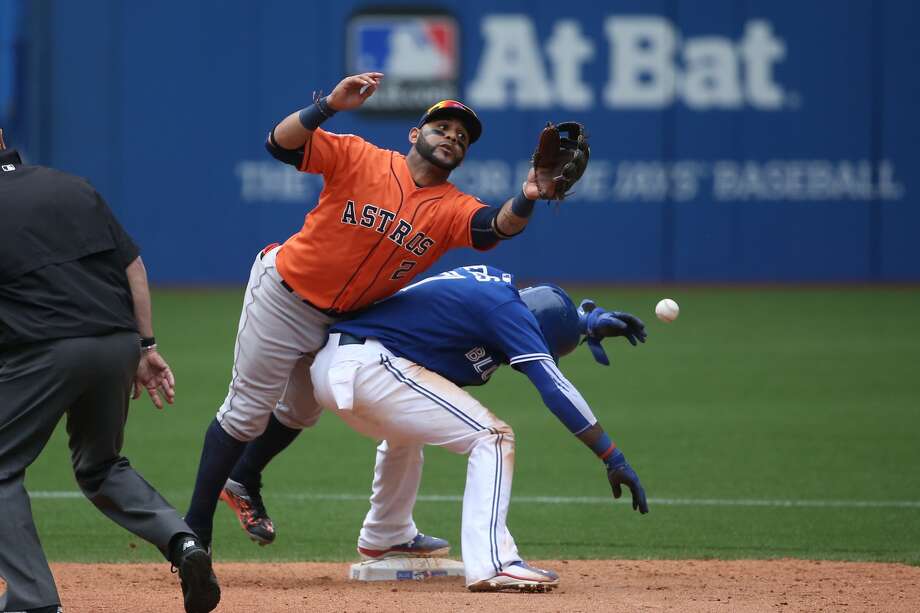
Good night, sweet prince.
*Luhnow talked about the reasoning behind promoting Correa:
Our team could use the spark right now. We haven't been playing our best baseball over the past few days and hopefully Carlos can add something that's been missing. We have to try and do everything we can to maintain our division lead and get this team to the postseason, and if calling up Carlos Correa helps us do that, that's what we're prepared for.
*In that previous link, Luhnow said he did talk with Jed Lowrie about bringing Correa up:
It's probably 33 games between now and the All-Star Game and you assume Jed's going to be back after the All-Star break, so that gives us a good amount of time to see how Carlos is doing and we'll determine at that point where everybody fits.
*Corpus manager Rodney Linares:
Carlos is going to be a good player for a long, long time. He's going to help us win championships, and he's also going to be a great ambassador for our game.
*ESPN's Christina Kahrl, on Correa's call-up:
This becomes just the most recent example of a team going young while also going for it, with examples like the Cubs this year, the Diamondbacks when they called up Paul Goldschmidt to solve their first-base problem en route to the 2011 postseason or the Braves bringing up Andruw Jones for the stretch run in 1996. It's a thing.
*The Astros close the book on the 2014 draft and get ready to open the 2015 draft. Luhnow:
We've been out scouting, we've been talking to advisors, players, parents, etc. I think more than anything, the fact that the Astros' plan seems to be coming together, and it's starting to work and make some sense, I think is drawing more interest to players potentially signing with us. So I think we're in a pretty good spot.
*Cole Hamels is, diplomatically, happy in Philadelphia.
So we close with the two lasting images of Jonathan Villar's tenure:
Good night, sweet prince.
Happy Carlos Correa Day (plus Day 1 Draft Primer)
The Astros recently announced that Carlos Correa will join the Astros in Chicago in time for the first game of the series against the White Sox. Correa will join the Astros at the expense of Handsome Jake (Buchanan), who will be optioned to Fresno. Because Correa is not on the 40-man, a corresponding move will also have to be made, and Deduno to the 60-man is one possibility.
Correa joins the Astros nearly exactly three years after he was drafted first in the 2012 draft (3 years, 4 days to be exact). Correa played in short-season / rookie league ball that year, then Lo-A Quad Cities in 2013 and Lancaster in 2014. His season in Lancaster ended with a broken leg - it was initially reported as a broken tibia, but more recently has been reported as a broken fibula. Regardless of the exact bone broken, it was a break in the sense that it was reported that the ankle ligament took a bit of bone off the bottom of the leg, which is unlikely to be a career threatening injury without some kind of serious and rare complication.
Correa's travels in 2015 are well documented. He burned through the Texas League, raking to the tune of .385/.459/.726 in 133 plate appearances, then he continued his solid season in AAA Fresno, hitting .266/.336/.447 in 107 plate appearances. Correa has a combined 18 stolen bases between the two levels, with one caught stealing. He has 10 home runs - seven in AA. He seems to have cooled off lately, but a counter-argument is that he was probably ready for the Majors in Spring Training, and didn't really need to head to AA.
Regardless of what the numbers say, the Astros clearly think that he is ready. The super-two deadline has likely passed, partly thanks to the early promotion of prospects like Kris Bryant and Houston's own Lance McCullers. The Astros could also use a spark - they seem to have hit a flat point in their season - and if Correa gets off to a hot start, Valbuena could be the one displaced when Jed Lowrie returns.
The irony is that just as the Astros promote one minor-league shortstop, they are highly likely to draft another tomorrow. Tomorrow is the Rule 4 draft - and the first 40-odd picks will be made tomorrow. As any reasonable Astros fan knows, they have picks two and five, which puts them in a stunning position because no team has had two draft picks that high. The linked article explains that teams in a similar position (i.e. two early draft picks) have done pretty well out of those picks, but that the Astros are even better placed than pretty much every team in history because they have four of the first 46 picks along with two of the first five picks.
Complicating this, however, is industry consensus that the top of the draft is weaker than in most years. I listened closely to Kiley McDaniel and Jim Callis over the weekend, and they agreed that this year seems to be a poor year to be picking early. Both pundits wonder whether there is a player worth five or six million in this draft, and both speculated as to where the consensus top hitter and pitcher would go if they were in the 2014 or 2016 drafts. So while the Astros may have an amazing opportunity, the draft class may not be in their favour - perhaps. It's a draft, so we probably won't know for 8 years or so.
The top three picks seem to all be three shortstops, which is how they relate directly to Correa's promotion. All three seem to have the glove to stay at short, and all are significant offensive producers. Dansby Swanson from Vanderbilt seems to be rated at the top of most draft boards - probably including the Astros' - and if he slides past the Diamondbacks, he probably won't get to number three. No one really knows what the Diamondbacks are going to do, but the consensus seems to be that Swanson is the choice here, although cutting an under-slot deal with someone in the 10-20 range (á la Carlos Correa in 2012, without the 10-20 range bit) remains a possibility. That player may be Tyler Stephenson, a catcher from Georgia. If Stephenson's name is read out first, then celebrate, Astros fans, because the Astros are going to get an opportunity to select the player they really want.
The other two shortstops are Alex Bregman from LSU, and Brandan Rodgers, a high school shortstop from Florida. Bregman is first on the board at minorleagueball.com, and Rodgers was the closest thing to a consensus top prospect heading into the 2015 draft year. He has done little to quieten the hype, but has also not really excelled.
There are a couple of other factors at play here, and much depends on the D-backs' selection. The Astros may not take a shortshop with the second pick if Arizona takes someone like Stephenson, because they know that one of the three shortstops will still be there when they choose at number five. Another whisper is that one of the college shortstops will be taken at two, because the Astros want to choose a high schooler at 5 - such as Mike Cameron's son Daz, or Preston Tucker's brother Kyle. Another whisper is that Daz Cameron is demanding 5 mil as a draft price, and is prepared to slide if teams won't meet that demand. One comment that I heard over the weekend is that Cameron could slide to 37, whereupon the Astros could snaffle him, and save enough with the first two picks to sign Cameron for five-large. Also watch out for Andrew Benintendi, a college outfield sophomore, as the number 5 pick if the Astros choose Brendan Rodgers at number 2.
Couple of other stories will also bear watching. Perhaps Brady Aiken's medicals are better-than-expected, and most articles that I have read project him to go to the Dodgers at 24 at lowest. Mac Marshall is a second- or third-round talent (#146 on minorleagueball.com), and seems keen to have a relationship with the Astros, so perhaps they get him the second time around. And not many polished pitchers, so any arms the Astros may take early (in their first two picks) are probably projects, and may be picked because of what it allows the Astros to do later in the draft.
So the circle of life continues. The Astros will promote one shortstop, and will have ample opportunity to draft another shortstop tomorrow. Talent be damned - perhaps the draft class is not as strong as what it has been in previous years, but nothing can be done about that. Regardless, the Astros have a unique opportunity to add some serious talent to the organisation in the next few days. Jeff Luhnow made his name in baseball clocking a couple of drafts for the Cardinals, and the 2012 draft for the Astros certainly looks pretty good at the moment. Hopefully the same will occur in 2015.
Whatever happens, it will be interesting.
Correa joins the Astros nearly exactly three years after he was drafted first in the 2012 draft (3 years, 4 days to be exact). Correa played in short-season / rookie league ball that year, then Lo-A Quad Cities in 2013 and Lancaster in 2014. His season in Lancaster ended with a broken leg - it was initially reported as a broken tibia, but more recently has been reported as a broken fibula. Regardless of the exact bone broken, it was a break in the sense that it was reported that the ankle ligament took a bit of bone off the bottom of the leg, which is unlikely to be a career threatening injury without some kind of serious and rare complication.
Correa's travels in 2015 are well documented. He burned through the Texas League, raking to the tune of .385/.459/.726 in 133 plate appearances, then he continued his solid season in AAA Fresno, hitting .266/.336/.447 in 107 plate appearances. Correa has a combined 18 stolen bases between the two levels, with one caught stealing. He has 10 home runs - seven in AA. He seems to have cooled off lately, but a counter-argument is that he was probably ready for the Majors in Spring Training, and didn't really need to head to AA.
Regardless of what the numbers say, the Astros clearly think that he is ready. The super-two deadline has likely passed, partly thanks to the early promotion of prospects like Kris Bryant and Houston's own Lance McCullers. The Astros could also use a spark - they seem to have hit a flat point in their season - and if Correa gets off to a hot start, Valbuena could be the one displaced when Jed Lowrie returns.
The irony is that just as the Astros promote one minor-league shortstop, they are highly likely to draft another tomorrow. Tomorrow is the Rule 4 draft - and the first 40-odd picks will be made tomorrow. As any reasonable Astros fan knows, they have picks two and five, which puts them in a stunning position because no team has had two draft picks that high. The linked article explains that teams in a similar position (i.e. two early draft picks) have done pretty well out of those picks, but that the Astros are even better placed than pretty much every team in history because they have four of the first 46 picks along with two of the first five picks.
Complicating this, however, is industry consensus that the top of the draft is weaker than in most years. I listened closely to Kiley McDaniel and Jim Callis over the weekend, and they agreed that this year seems to be a poor year to be picking early. Both pundits wonder whether there is a player worth five or six million in this draft, and both speculated as to where the consensus top hitter and pitcher would go if they were in the 2014 or 2016 drafts. So while the Astros may have an amazing opportunity, the draft class may not be in their favour - perhaps. It's a draft, so we probably won't know for 8 years or so.
The top three picks seem to all be three shortstops, which is how they relate directly to Correa's promotion. All three seem to have the glove to stay at short, and all are significant offensive producers. Dansby Swanson from Vanderbilt seems to be rated at the top of most draft boards - probably including the Astros' - and if he slides past the Diamondbacks, he probably won't get to number three. No one really knows what the Diamondbacks are going to do, but the consensus seems to be that Swanson is the choice here, although cutting an under-slot deal with someone in the 10-20 range (á la Carlos Correa in 2012, without the 10-20 range bit) remains a possibility. That player may be Tyler Stephenson, a catcher from Georgia. If Stephenson's name is read out first, then celebrate, Astros fans, because the Astros are going to get an opportunity to select the player they really want.
The other two shortstops are Alex Bregman from LSU, and Brandan Rodgers, a high school shortstop from Florida. Bregman is first on the board at minorleagueball.com, and Rodgers was the closest thing to a consensus top prospect heading into the 2015 draft year. He has done little to quieten the hype, but has also not really excelled.
There are a couple of other factors at play here, and much depends on the D-backs' selection. The Astros may not take a shortshop with the second pick if Arizona takes someone like Stephenson, because they know that one of the three shortstops will still be there when they choose at number five. Another whisper is that one of the college shortstops will be taken at two, because the Astros want to choose a high schooler at 5 - such as Mike Cameron's son Daz, or Preston Tucker's brother Kyle. Another whisper is that Daz Cameron is demanding 5 mil as a draft price, and is prepared to slide if teams won't meet that demand. One comment that I heard over the weekend is that Cameron could slide to 37, whereupon the Astros could snaffle him, and save enough with the first two picks to sign Cameron for five-large. Also watch out for Andrew Benintendi, a college outfield sophomore, as the number 5 pick if the Astros choose Brendan Rodgers at number 2.
Couple of other stories will also bear watching. Perhaps Brady Aiken's medicals are better-than-expected, and most articles that I have read project him to go to the Dodgers at 24 at lowest. Mac Marshall is a second- or third-round talent (#146 on minorleagueball.com), and seems keen to have a relationship with the Astros, so perhaps they get him the second time around. And not many polished pitchers, so any arms the Astros may take early (in their first two picks) are probably projects, and may be picked because of what it allows the Astros to do later in the draft.
So the circle of life continues. The Astros will promote one shortstop, and will have ample opportunity to draft another shortstop tomorrow. Talent be damned - perhaps the draft class is not as strong as what it has been in previous years, but nothing can be done about that. Regardless, the Astros have a unique opportunity to add some serious talent to the organisation in the next few days. Jeff Luhnow made his name in baseball clocking a couple of drafts for the Cardinals, and the 2012 draft for the Astros certainly looks pretty good at the moment. Hopefully the same will occur in 2015.
Whatever happens, it will be interesting.
Monday, May 25, 2015
2005 vs 2015
A note before you begin: this was written during the Astros/Orioles game. All 2015 stats are valid as of the end of play, May 24. All 2005 stats ave been valid for nine years now.
Hey whaddayaknow the Astros are good again! It's debatable the last time the Astros were actually good. 2006 wasn't a bad year. 2008 was going really well until Hurricane Ike hit and at least made an endpoint not so arbitrary. So we're back to 2005 when the Astros - of course - were in the World Series for about six days. Comparisons have been made between the 2015 Astros and the 2005 Astros, presumably because it's the last time anyone really had fun watching them, besides being interrupted by a terrible natural disaster. How alike are the two teams? Let's take a look.
Well you can immediately rule out Hot Start, which the 2015 Astros are enjoying. Ten years ago today (May 25, 2005) the Astros started the day 15-30 - bringing out the famous Tombstone edition - but would finish the season 74-43 and make the World Series. These Astros are 29-16 while I watch them play the Orioles.
How about roster construction? The average age of the 2005 Houston Astros was 30.4 years old. Craig Biggio was 39 years old, Jeff Bagwell was 37, Brad Ausmus was 36. The 2005 Astros got 436 plate appearances from 37-year old Jose Vizcaino and 36-year old Orlando Palmeiro. The youngest player on the team was 23-year old Willy Taveras. Chris Burke was 25. Everyone position player who received a plate appearance was 27 or over. The rotation featured a 26-year old Wandy Rodriguez, 27-year olds Roy Oswalt and Brandon Backe, 33-year old Andy Pettitte, and 42-year old Roger Clemens. The youngest relievers were Chad Qualls and Mike Burns (26) giving the Astros' pitchers an average age of 30.5 (Clemens and 44-year old John Franco didn't help the old average).
The 2015 Astros are obviously not veteran-heavy, at least not that veteran heavy. The average age on the team is 26.8 years old. Jed Lowrie is the only position player over 30. Luis Valbuena is the Old Man on the field, in his Age 29 season; Castro, Carter, Rasmus, and Gattis are all in their Age 28 seasons. Marwin is 26, Altuve and Springer are 25, and Marisnick is 24. There are a couple of veterans in the rotation, with Fausto (34) and Feldman (32), but McHugh is 28, Keuchel is 26 and for now McCullers is 21. All of the bullpen is over 30, with Qualls as the reigning sage of the group. So we immediately see that the 2015 Astros team is much younger than the 2005 Astros.
When judging offense, it's important to take into account that pitchers were hitting every 9th plate appearance. That said...
Of course we already have a full season's worth of stats for the 2005 Astros, and the 2015 team is currently playing their 46th game as I write this. What do we see? Nothing new or groundbreaking: the 2015 Astros have sacrificed average for power, and their pitching and defense is solid. So what, right? If we compare the 2015 Astros to the 2005 Astros, though, we see that the offense - including Gattis, Carter, and Springer - is keeping up with, and in some ways exceeding, that of the World Series team.
And the pitching. Well, then. I wasn't expecting this part. While the ERA+ is lower/worse for the 2015 team, the ERA/FIP is right there with the Pettitte/Clemens/Oswalt rotation. The 2015 groundball rate is the best in baseball, much better than in 2005, and the K:BB ratio is half a strikeout better than the 2005 one.
In other words - and maybe this isn't a surprise - but the 2015 Astros have a pitching staff at least in whispering distance of 2005, while the 2015 version has more power (the 2015 Astros' ISO is .184, 32 points better than 2005.
The roster is constructed completely differently - 2005 had what I would consider a more traditional offense - an offense built to win in the waning years of Biggio and Bagwell's careers and getting production from a few key players and positions. Chris Burke and Willy Taveras had an OPS+ of 76 and 75, respectively. Berkman and Ensberg, on the other hand, each had an OPS+ over 140.
2015 is pretty unconventional - built around young, controllable players presumably in their prime (or reaching it in the next couple of years) who are 29-16 despite four starters hitting .210 or under, valuing different aspects of the game entirely - getting groundballs hit into a defense that looks like the end of an electronic football game, with an offense that will swing for the fences and connect just often enough to win most games. Six of the starters have an OPS+ of at least 90, while four sit above 100 (Altuve, Marisnick, Rasmus, Springer). There is production - or at least the promise of production - up and down the lineup. It's not always pretty, but - for now - it's working.
Hey whaddayaknow the Astros are good again! It's debatable the last time the Astros were actually good. 2006 wasn't a bad year. 2008 was going really well until Hurricane Ike hit and at least made an endpoint not so arbitrary. So we're back to 2005 when the Astros - of course - were in the World Series for about six days. Comparisons have been made between the 2015 Astros and the 2005 Astros, presumably because it's the last time anyone really had fun watching them, besides being interrupted by a terrible natural disaster. How alike are the two teams? Let's take a look.
Well you can immediately rule out Hot Start, which the 2015 Astros are enjoying. Ten years ago today (May 25, 2005) the Astros started the day 15-30 - bringing out the famous Tombstone edition - but would finish the season 74-43 and make the World Series. These Astros are 29-16 while I watch them play the Orioles.

How about roster construction? The average age of the 2005 Houston Astros was 30.4 years old. Craig Biggio was 39 years old, Jeff Bagwell was 37, Brad Ausmus was 36. The 2005 Astros got 436 plate appearances from 37-year old Jose Vizcaino and 36-year old Orlando Palmeiro. The youngest player on the team was 23-year old Willy Taveras. Chris Burke was 25. Everyone position player who received a plate appearance was 27 or over. The rotation featured a 26-year old Wandy Rodriguez, 27-year olds Roy Oswalt and Brandon Backe, 33-year old Andy Pettitte, and 42-year old Roger Clemens. The youngest relievers were Chad Qualls and Mike Burns (26) giving the Astros' pitchers an average age of 30.5 (Clemens and 44-year old John Franco didn't help the old average).
The 2015 Astros are obviously not veteran-heavy, at least not that veteran heavy. The average age on the team is 26.8 years old. Jed Lowrie is the only position player over 30. Luis Valbuena is the Old Man on the field, in his Age 29 season; Castro, Carter, Rasmus, and Gattis are all in their Age 28 seasons. Marwin is 26, Altuve and Springer are 25, and Marisnick is 24. There are a couple of veterans in the rotation, with Fausto (34) and Feldman (32), but McHugh is 28, Keuchel is 26 and for now McCullers is 21. All of the bullpen is over 30, with Qualls as the reigning sage of the group. So we immediately see that the 2015 Astros team is much younger than the 2005 Astros.
When judging offense, it's important to take into account that pitchers were hitting every 9th plate appearance. That said...
| 2005 | 2015 | ||
|---|---|---|---|
| Slash | .256/.322/.408 | .231/.303/.415 | |
| K:BB (bat) | 2.16 | 2.76 | |
| HR/G | 0.99 | 1.42 | |
| Run Diff/Gm | +0.51 | +0.60 | |
| OPS+ | 90 | 99 | |
| WAR (Bat) | 18.1 | 5.3 | |
| K:BB (pitch) | 2.65 | 3.15 | |
| ERA/FIP | 3.52/3.84 | 3.56/3.53 | |
| GB% | 46.4% | 50.9% | |
| ERA+ | 121 | 115 | |
| WAR (Pitch) | 22.6 | 5.9 |
Of course we already have a full season's worth of stats for the 2005 Astros, and the 2015 team is currently playing their 46th game as I write this. What do we see? Nothing new or groundbreaking: the 2015 Astros have sacrificed average for power, and their pitching and defense is solid. So what, right? If we compare the 2015 Astros to the 2005 Astros, though, we see that the offense - including Gattis, Carter, and Springer - is keeping up with, and in some ways exceeding, that of the World Series team.
And the pitching. Well, then. I wasn't expecting this part. While the ERA+ is lower/worse for the 2015 team, the ERA/FIP is right there with the Pettitte/Clemens/Oswalt rotation. The 2015 groundball rate is the best in baseball, much better than in 2005, and the K:BB ratio is half a strikeout better than the 2005 one.
In other words - and maybe this isn't a surprise - but the 2015 Astros have a pitching staff at least in whispering distance of 2005, while the 2015 version has more power (the 2015 Astros' ISO is .184, 32 points better than 2005.
The roster is constructed completely differently - 2005 had what I would consider a more traditional offense - an offense built to win in the waning years of Biggio and Bagwell's careers and getting production from a few key players and positions. Chris Burke and Willy Taveras had an OPS+ of 76 and 75, respectively. Berkman and Ensberg, on the other hand, each had an OPS+ over 140.
2015 is pretty unconventional - built around young, controllable players presumably in their prime (or reaching it in the next couple of years) who are 29-16 despite four starters hitting .210 or under, valuing different aspects of the game entirely - getting groundballs hit into a defense that looks like the end of an electronic football game, with an offense that will swing for the fences and connect just often enough to win most games. Six of the starters have an OPS+ of at least 90, while four sit above 100 (Altuve, Marisnick, Rasmus, Springer). There is production - or at least the promise of production - up and down the lineup. It's not always pretty, but - for now - it's working.
Friday, May 15, 2015
Baseball America's Mock Draft
Baseball America released their second mock draft this afternoon, and here's who they have the Astros taking:
1-2: John Manuel says the Astros really like Carson Fulmer, but projects the D'Backs to take him with the 1-1. In this mock draft, Manuel has the Astros taking Vanderbilt shortstop Dansby Swanson, who sounds like he would be more at home at dinner with Jay Gatsby.
1-5: While Vandy pitcher Walker Buehler (a character from William Faulkner's "As I Lay Dying") is a sleeper pick here, Manuel has the Astros taking Preston Tucker's brother Kyle, an outfielder from Plant (FL) High School.
As an aside, Manuel has Brady Aiken going to the Dodgers at 1-24.
1-2: John Manuel says the Astros really like Carson Fulmer, but projects the D'Backs to take him with the 1-1. In this mock draft, Manuel has the Astros taking Vanderbilt shortstop Dansby Swanson, who sounds like he would be more at home at dinner with Jay Gatsby.
1-5: While Vandy pitcher Walker Buehler (a character from William Faulkner's "As I Lay Dying") is a sleeper pick here, Manuel has the Astros taking Preston Tucker's brother Kyle, an outfielder from Plant (FL) High School.
As an aside, Manuel has Brady Aiken going to the Dodgers at 1-24.
Monday, May 4, 2015
.500 Watch and Divisional Schedules
The Constable recently posted a fabulous article on the first 25 games, so check it out if you haven't already looked at it. I wondered about doing this article and the associated game recap, because it would also knock the Constable's article off the front page. It is really worth a read.
A couple of days ago, I presented the record the Astros would have if they played .500 ball for the rest of the season. I think it is an interesting exercise, because it acknowledges that the Astros probably won't win 116 games (thanks, Constable) by sustaining their current pace, but it accounts for the wins that the Astros have already banked to this point in the season. These are wins that will not be taken away from them becausebaseball has a new commissioner it is not allowed in the rules of the game. The .500 watch puts the Astros' record at 86-75 entering the last game of the season.
I also talked a couple of days ago about how few games the AL West - holders of the Hardest Division in Baseball title - have played against teams outside their division. No other AL West team currently has a .500 record - the Angels are the next best at 11-14. All AL West teams have played either 26 (Oakland), 25 (Houston, LA and Seattle) or 24 (Texas) games, so the AL West in total has played 125 games.
With the early season schedule relying heavily on intra-division games, it is important to note that only 23 games have been played by AL West teams against teams outside the division. The combined record in those games are 7-16. The Angels haven't won a game against an opponent outside the AL West in six attempts, and the Mariners have also been the victims of an inter-league sweep already this year. Only the Astros have a winning out-of-division record (4-2), mostly by virtue of a sweep of the Padres.
So some of the unimpressive records of the AL West teams could be due to the intradivision dominance at the hands of the Astros. But AL West teams are also under performing - at least to this point - against teams outside the division. What this adds up to is a great situation for the Astros, with an early 7 game lead, partly built by a strong record within the division (14-5 record), and partly built by the weaknesses of the other AL West teams.
And lets face it. All the AL West teams have significant weaknesses. The Astros have very limited starting pitching depth. Ditto the Angels, plus a hole at second base, and a dodgy 'pen. Oakland perhaps has the best rotation, but their 'pen isn't fabulous, and their lineup lacks a wow factor at the moment. Seattle is interesting, but globally under performing, and Texas have been the victims of a crippling plague of injuries over the last 18 months, and are having to trial a pack of replacement-level players. I would think that Seattle is the team most likely to overtake the Astros if the Astros don't win the division, since they still look like the best all-round unit on paper, and have the fewest weaknesses.
So I am thinking of the Astros' hot play not as the expected rate of winning for the rest of the season, but as banking wins in close games. It is fabulous that this has happened with the core of the lineup not contributing. If they maintain a perfectly realistic record from here (.500), they will be entering the last game of the season with 86 wins on the board. That may be enough to take the division because (i) of their early-season dominance inside the division and (ii) the other teams all have significant weaknesses. But the records of the AL West teams may stabilise quickly, especially as a couple of the stronger teams start to perform better in out-of-division games. The AL West may start to resemble the solid division it looked like last year once the early season intradivision part of the schedule ends.
Writing about stuff like this sure beats writing recaps in a 90+ loss season, huh?
A couple of days ago, I presented the record the Astros would have if they played .500 ball for the rest of the season. I think it is an interesting exercise, because it acknowledges that the Astros probably won't win 116 games (thanks, Constable) by sustaining their current pace, but it accounts for the wins that the Astros have already banked to this point in the season. These are wins that will not be taken away from them because
I also talked a couple of days ago about how few games the AL West - holders of the Hardest Division in Baseball title - have played against teams outside their division. No other AL West team currently has a .500 record - the Angels are the next best at 11-14. All AL West teams have played either 26 (Oakland), 25 (Houston, LA and Seattle) or 24 (Texas) games, so the AL West in total has played 125 games.
With the early season schedule relying heavily on intra-division games, it is important to note that only 23 games have been played by AL West teams against teams outside the division. The combined record in those games are 7-16. The Angels haven't won a game against an opponent outside the AL West in six attempts, and the Mariners have also been the victims of an inter-league sweep already this year. Only the Astros have a winning out-of-division record (4-2), mostly by virtue of a sweep of the Padres.
So some of the unimpressive records of the AL West teams could be due to the intradivision dominance at the hands of the Astros. But AL West teams are also under performing - at least to this point - against teams outside the division. What this adds up to is a great situation for the Astros, with an early 7 game lead, partly built by a strong record within the division (14-5 record), and partly built by the weaknesses of the other AL West teams.
And lets face it. All the AL West teams have significant weaknesses. The Astros have very limited starting pitching depth. Ditto the Angels, plus a hole at second base, and a dodgy 'pen. Oakland perhaps has the best rotation, but their 'pen isn't fabulous, and their lineup lacks a wow factor at the moment. Seattle is interesting, but globally under performing, and Texas have been the victims of a crippling plague of injuries over the last 18 months, and are having to trial a pack of replacement-level players. I would think that Seattle is the team most likely to overtake the Astros if the Astros don't win the division, since they still look like the best all-round unit on paper, and have the fewest weaknesses.
So I am thinking of the Astros' hot play not as the expected rate of winning for the rest of the season, but as banking wins in close games. It is fabulous that this has happened with the core of the lineup not contributing. If they maintain a perfectly realistic record from here (.500), they will be entering the last game of the season with 86 wins on the board. That may be enough to take the division because (i) of their early-season dominance inside the division and (ii) the other teams all have significant weaknesses. But the records of the AL West teams may stabilise quickly, especially as a couple of the stronger teams start to perform better in out-of-division games. The AL West may start to resemble the solid division it looked like last year once the early season intradivision part of the schedule ends.
Writing about stuff like this sure beats writing recaps in a 90+ loss season, huh?
Subscribe to:
Posts (Atom)